


Nobody tells you about the specific kind of dread that comes with staring at an empty client list.
You’ve set up your profile. You’ve decided on your service. You might have even made a little logo or picked a niche. And then you sit there, ready to work, with absolutely nobody to work for.
That gap — between “I’ve decided to freelance” and “I have an actual paying client” — is where most people quietly give up. Not because they lack skill. Not because the market doesn’t need what they offer. But because nobody told them what to actually do in those first few weeks to get momentum going.
I spent about six weeks in that gap. I applied to jobs on Upwork, waited, refreshed my email, and applied to more jobs. I got one response — a guy who wanted 10 blog posts for $15 total. I declined. Then more silence.
What broke me out of it wasn’t a new platform or a viral post. It was a shift in strategy — from waiting for clients to find me, to actively putting myself in front of the right people. That sounds simple. The execution took some figuring out.
Here’s what actually works — pulled from my own experience and watching a lot of other freelancers go through the same process.
First, Accept That Your First Client Will Probably Come from Your Existing World
This is the thing people resist hearing. Everyone wants a clean story about building a portfolio, crafting the perfect proposal, and landing a stranger as their first client through sheer professionalism.
That’s not usually how it goes.
Most people’s first freelance client is someone they already know — or someone two degrees away. A former colleague who now runs a small business. A family friend who mentioned they needed a website. A college classmate who started an online store. A neighbor who’s been complaining that they have no time to post on Instagram.
The reason this works isn’t charity. It’s trust. A stranger on Upwork has to evaluate you entirely based on your profile and a short proposal. Someone who already knows you — or knows someone who knows you — starts with a level of basic trust that dramatically lowers the barrier to saying yes.
So before you spend hours refining your Upwork profile or crafting cold outreach emails to strangers, spend thirty minutes making a list. Write down every person you know who runs a business or works closely with one. Neighbors, relatives, former bosses, old classmates, people from your religious community, anyone from your last job.
You’re not looking for someone who needs exactly what you offer right now. You’re looking for people who might, or who might know someone who does.
The “Soft Announcement” That Works Better Than a Sales Pitch
Once you have your list, you don’t need to go around selling to people. That makes everyone uncomfortable — including you.
What works instead is a genuine, low-pressure announcement that you’re now doing this work professionally. Something like a message to people you’re already in contact with, or a post on your personal social media:
“Hey — in case anyone’s wondering what I’ve been up to lately, I’ve started doing freelance [content writing / graphic design / social media management / whatever] for small businesses. If you know anyone who could use help with that, I’d really appreciate the referral. Happy to answer any questions.”
That’s it. No hard sell. No list of packages and prices. Just a clear statement of what you’re doing and an easy ask (a referral, not a direct order).
You’ll be surprised. People genuinely like being in a position to help connect others, especially when it feels easy and natural. One message like this has led to first clients for more freelancers than any platform or cold email strategy.
How to Approach Platforms Without Getting Lost in Them
Once you’ve worked your existing network and come up empty — or while you’re working it — you need to be on freelance platforms. But the approach matters enormously.
On Upwork, the biggest mistake beginners make is applying to the highest-traffic jobs with vague, generic proposals. Those jobs have fifty applicants within hours. Your generic proposal, no matter how polished, disappears into the pile.
What works better: apply to jobs posted by newer clients (look for accounts with few reviews or no review history), smaller budget projects, and jobs that have been up for a while with few proposals. Less competition, more opportunity for your proposal to actually be read.
Your proposal should open with something that shows you actually read their job post — not a generic intro. If the job is “need a writer for our pet care blog,” don’t open with “I am a professional writer with extensive experience.” Open with something like: “Pet care content is an interesting space — readers range from anxious first-time owners to experienced breeders, and the tone has to work for both. Here’s how I’d approach that…”
That opening makes them stop and actually read the rest.
On Fiverr, the strategy is different. You’re not applying to jobs — you’re creating gigs and waiting for buyers to find you. Which means getting that first order is partly about SEO (your gig title and tags matching what buyers search for) and partly about actively driving traffic to your gig early on.
The Buyer Requests / Briefs section on Fiverr (the feature name has changed slightly across updates) is worth checking daily when you’re starting out. Buyers post what they need, and sellers can respond. It’s one of the fastest ways to get first orders without waiting for your gig to rank organically.
LinkedIn is genuinely underutilized by freelancers, especially those who aren’t in traditionally corporate-facing services. But small business owners, startup founders, and marketing managers — all of whom need freelancers regularly — are active on LinkedIn.
Optimize your LinkedIn headline to reflect your freelance work (not your last job title). Post occasional short pieces about your area of expertise. And don’t underestimate direct outreach — a brief, genuine message to someone whose business you’ve researched, explaining specifically how you might help them, gets a better response rate than most people expect.
 The Cold Outreach Approach That Doesn’t Feel Like Spam
 The Cold Outreach Approach That Doesn’t Feel Like Spam
Cold outreach has a bad reputation because most people do it badly — mass messages with “Dear Sir/Madam” energy, no personalization, and a desperate pitch to buy their services.
Done right, it’s different. And it works.
The formula: find a specific business whose online presence, content, or process has a visible gap you could fill. Then reach out with a short, specific message that leads with what you noticed and how you’d address it — not a generic pitch about your services.
For example, if you’re a social media manager and you find a local bakery with great products but an Instagram that hasn’t been updated in three months:
“Hi [Name] — I came across your bakery through [wherever] and your pastries look incredible. I noticed your Instagram has been quiet lately — that’s actually the kind of gap I help local food businesses fix. I manage social media content for small shops and I’d love to share a quick idea I had for your account, no pitch attached. Would you be open to a five-minute chat?”
That’s not spam. It’s a personalized, specific observation with a low-stakes ask. The reason it works: you’ve done real homework, you’ve identified a real problem, and you’re not asking for money upfront — just a conversation.
You need to send a lot of these before you get a response. Fifteen to twenty in a week is realistic. But the response rate on good cold outreach is meaningfully higher than blindly applying to job boards.
The “Build in Public” Shortcut to Inbound Interest
This strategy takes a few weeks to pay off, but it creates momentum that compounds over time.
The idea: start sharing what you know publicly — on LinkedIn, Twitter/X, Instagram, or wherever your potential clients spend time. Not promotional posts about your services, but genuinely useful content about your area of expertise.
A social media manager might post about why most small business Instagram accounts post at the wrong time. A copywriter might share why most “About Us” pages lose readers in the first sentence. A web developer might break down three things that make a local business website look unprofessional.
Posts like these do two things. They establish you as someone who actually knows what they’re talking about. And they attract people who are experiencing exactly the problems you’re describing — often people who are now thinking “I should hire someone who understands this.”
This isn’t an overnight strategy. But consistently doing this for four to six weeks, even once or twice a week, starts generating inbound interest that you don’t have to chase.
Offer a Specific, Time-Limited Trial Project
This is a move that makes a lot of beginner freelancers uncomfortable, but it’s one of the most effective ways to break the “no experience = no clients = no experience” loop.
The idea is to offer a single, clearly defined small project — not your full service package — at a reduced rate, in exchange for honest feedback and a testimonial if they’re happy.
The key word is specific. Not “I’ll do some writing for cheap.” Something like: “I’ll write one sample blog post on a topic of your choice, 800 words, optimized for your target keyword. If you like the quality, we can talk about ongoing work. If not, you owe me nothing and keep the post.”
That’s a nearly zero-risk offer for the client. And for you, it gets you a real project with real stakes, a real piece for your portfolio, and — most importantly — a real relationship with a real business.
Do this with two or three carefully chosen businesses and you have a portfolio, testimonials, and client references. The “no experience” problem is gone.
What to Do the Moment Someone Says Yes
This is something nobody prepares beginners for: the mini-panic that happens when a prospect actually agrees to work with you.
Have a few things ready before you get to that moment:
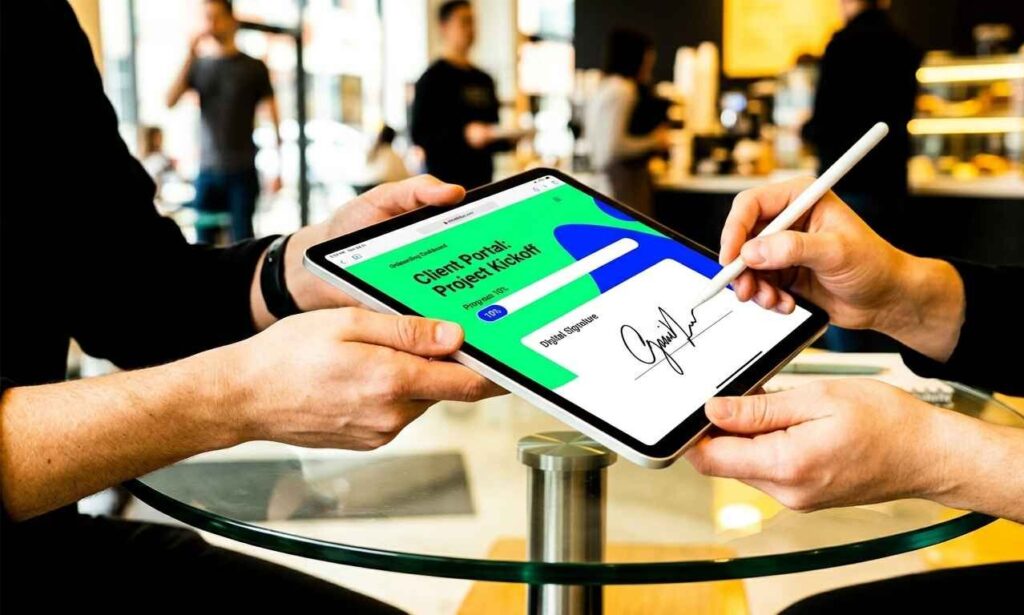
A basic written agreement. Even a simple one-page document stating what you’ll deliver, the timeline, the rate, and how many revisions are included. HelloSign, Bonsai, or even a clean Google Doc works. Never work on a handshake alone — not because people are dishonest, but because misaligned expectations are the main cause of freelance disputes.
An invoice template. Wave is free and professional-looking. PayPal business works. Payoneer if you’re working with international clients. Know how you’re going to send an invoice before you need to.
A clear intake process. A short list of questions you’ll ask before starting work — what they want, who the audience is, what “good” looks like to them, what they definitely don’t want. Starting a project without these answers leads to rework and disappointment on both sides.
The Mistake That Costs You the Second Client as Much as the First
Getting the first client is hard. But a mistake a lot of new freelancers make is treating the first project purely as a transaction — do the work, deliver it, move on.
The first client is also your best source of more clients.
After delivering good work, ask for a testimonial explicitly. Most happy clients don’t think to offer one unprompted. A short message works fine: “I really enjoyed working on this — would you be comfortable sharing a few sentences about your experience? I’d love to use it on my profile.”
And ask if they know anyone else who might benefit from the same kind of help. A warm referral from a satisfied client closes at a much higher rate than any cold outreach.
The freelancers who build a full client roster within their first six months almost always do it through a combination of referrals from early clients and a steadily growing body of work. The first client makes the second one easier. The second makes the third one easier. The compounding only starts once you land that first one.
The Honest Timeline
One more thing worth saying directly: getting your first freelance client typically takes two to six weeks of consistent, active effort. Not passive effort — active. Applying to jobs daily, sending outreach, posting content, following up.
If you’re doing all of that and still haven’t landed anything after a month, something in your positioning needs adjusting — your niche is too broad, your proposals sound like everyone else’s, or your rate is sending the wrong signal. Treat the feedback from the market as information and adjust, rather than giving up.
Most people who “tried freelancing and it didn’t work” stopped during the hardest part — the first few weeks before anything has clicked. The ones who kept going almost always found their footing.
That gap between deciding to freelance and having your first real client is uncomfortable. But it’s a fixed-size gap. You only have to cross it once.