

When I first started freelancing, I wasted about three months trying to figure out which platform to focus on. I had accounts on both Fiverr and Upwork, spread my energy across both, did mediocre on both, and convinced myself the problem was the platforms rather than my approach.
Eventually I talked to a writer who was pulling in $4,000–$5,000 a month consistently. She used only Upwork. Then I met a logo designer making similarly solid money, also consistently. He used only Fiverr. Neither of them touched the other platform.
That’s when it clicked for me: Fiverr and Upwork are not interchangeable tools. They work on completely different mechanics, attract different types of clients, and favor different types of freelancers. Picking the wrong one for how you work — or trying to split your energy equally between both — is a guaranteed way to get mediocre results on both.
So let me break down what I’ve actually experienced on each, where they each fall short, and how to figure out which one fits the way you want to work.
How Each Platform Actually Works
Before comparing them, it’s worth making sure we’re comparing the right things — because a lot of people don’t fully understand how each platform operates.
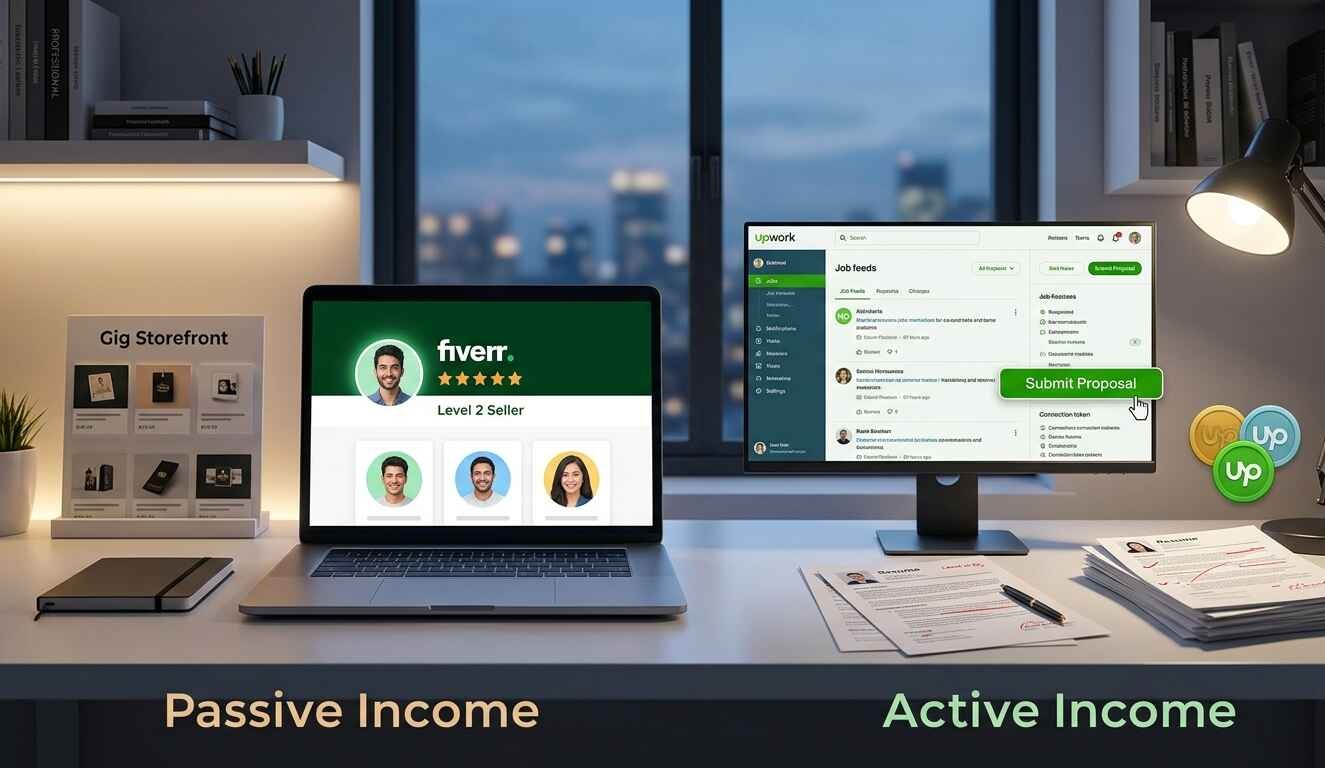
Fiverr is a marketplace where sellers create “gigs” — packaged, pre-defined services with set prices. Buyers browse and purchase directly, often without much back-and-forth beforehand. You’re essentially building a little storefront. The buyer comes to you, sees what you offer, sees the price, and decides whether to order.
Upwork works the other way around. Clients post jobs describing what they need, and freelancers apply by sending proposals. You’re going to the client, competing with other applicants, and making a case for why they should hire you specifically. It’s closer to a job application process.
That fundamental difference — passive (Fiverr) vs active (Upwork) — shapes almost everything else about how each platform works in practice.

The Fiverr Experience
When your gig is set up well and starts ranking, Fiverr is remarkable. Orders come in while you’re asleep. You wake up to notifications. There’s no pitching, no proposals, no competing in real time. Buyers find you, like what they see, and pay you.
That’s the upside.
The downside is getting to that point. New gigs on Fiverr have almost no organic visibility. The algorithm strongly favors gigs that already have orders, reviews, and strong completion rates. Which means when you’re starting out, you’re starting in near-total obscurity.
Getting your first few orders on Fiverr usually requires actively promoting your gig link — posting it in relevant communities, using the Buyer Requests/Briefs section to respond to what buyers are already looking for, sometimes even reaching out to people in your own network and asking them to purchase through the platform to kick-start your review history.
Who tends to do well on Fiverr:
- Designers (logo, brand identity, social media graphics, presentation design)
- Video editors and animators
- Voiceover artists
- Music producers and audio engineers
- Writers offering specific, packageable services (product descriptions, social media captions, CVs/resumes)
- Anyone whose work can be standardized into a repeatable, defined package
The key word there is packageable. Fiverr works best when your service can be clearly defined upfront: “I will do X for Y price, delivered in Z days.” If your work requires a lot of discovery, consultation, and customization before you can even scope it properly, Fiverr’s model gets awkward.
Fiverr’s fee structure: Fiverr takes 20% of every transaction. That’s a flat cut regardless of order size. You invoice $100, you keep $80. It’s simple and consistent, though 20% is on the higher end compared to some platforms.

The Upwork Experience
Upwork is more dynamic and, in many ways, more demanding — but it’s also where some of the best-paying freelance work lives.
Clients post jobs ranging from $20 micro-tasks to six-month contracts worth tens of thousands of dollars. You browse job posts, pick the ones that fit, and send proposals. Your proposal — essentially a short cover letter plus your bid — is what determines whether you get hired.
The good news: clients on Upwork are often more serious and better-funded than the average Fiverr buyer. Many are businesses, not individuals. They’re looking for ongoing relationships, not one-off transactions. If you land a solid client on Upwork, that relationship can be worth thousands of dollars over time — not a single $50 gig.
The bad news: proposals aren’t free. Upwork uses a system called “Connects” (essentially tokens) to submit proposals. You spend a certain number of Connects per application. New accounts get some free Connects, but you’ll need to buy more eventually. This adds a real cost to the job-hunting process, especially when you’re applying to a lot of jobs early on without getting responses.
The other thing to know: Upwork is not beginner-friendly in terms of competition. Popular job postings attract dozens of proposals within hours. Standing out requires a genuinely tailored, well-written proposal — and even then, clients often default to freelancers with more reviews. Getting those first few reviews is the biggest hurdle.
Who tends to do well on Upwork:
- Writers and content strategists working on long-form, ongoing content needs
- Web and app developers
- Digital marketers (SEO, paid ads, email marketing)
- Virtual assistants and executive assistants
- Data analysts and researchers
- Anyone offering services that require client consultation, project scoping, and a back-and-forth relationship
The work that performs best on Upwork is work where the project details can’t be fully defined until you’ve talked to the client — the opposite of what Fiverr does well.
Upwork’s fee structure: Upwork recently simplified its fees to a flat 10% across the board for most freelancers. That’s better than Fiverr’s 20%, though Upwork also charges for Connects, so there’s a cost to pitching that Fiverr doesn’t have.
Where Each Platform Falls Short
Fiverr’s real weaknesses:
The race to the bottom on pricing is real. Because buyers can sort by price and see your rate before they see much else about you, there’s constant pressure to price lower than you should — especially in competitive categories. Niching down and differentiating your gig is the way around this, but it takes time.
Fiverr also gives sellers relatively little control over client quality. A buyer can place an order without messaging you first, which means you sometimes end up with clients who had completely different expectations than what your gig described. Revision wars and unjustified negative reviews happen, and Fiverr’s resolution process is not always seller-friendly.
Upwork’s real weaknesses:
The proposal process can become demoralizing fast. You spend real effort crafting thoughtful proposals, spend Connects you’ve paid for, and often hear nothing back — not even a decline. High-traffic job posts are genuinely saturated with applicants.
Upwork’s algorithm also does something that frustrates newer users: it sometimes limits your proposal submission rate if your account doesn’t have enough activity or your Job Success Score drops. It can feel like the platform is working against you when you’re trying to build momentum.
There’s also the client quality inconsistency. Upwork has serious, well-funded clients and it has clients who post $10/hour development jobs expecting senior-level work. Learning to read job posts and client profiles to spot bad fits before applying is a skill that takes some trial and error to develop.
A Side-by-Side Look at What Actually Matters
| Factor | Fiverr | Upwork |
|---|---|---|
| How you get work | Buyers come to you | You apply to client jobs |
| Best for | Packageable, defined services | Complex, consultative, ongoing work |
| Starting difficulty | Hard to rank; need to drive early traffic | Hard to compete early; proposal costs real money |
| Client quality | Variable; many one-time buyers | Variable; more long-term business clients |
| Fee structure | 20% flat cut | 10% flat cut + Connects cost |
| Income ceiling | Moderate (gig model limits scope) | Higher (long-term contracts, large projects) |
| Schedule flexibility | High (you set delivery times) | Medium (clients may expect availability) |
| Best service types | Design, audio, video, standardized writing | Development, strategy, writing, marketing, VA |
What Type of Freelancer Should Choose Which Platform
Choose Fiverr if:
You offer a service that’s easy to define and package. You prefer not to spend time on proposals and would rather set up your service once and let it run. You’re a designer, voiceover artist, video editor, or anyone else whose deliverable is clear and consistent across different buyers. You want maximum schedule flexibility and don’t want an ongoing relationship with clients beyond the project.
Choose Upwork if:
You offer services that require scoping, conversation, and customization — development, copywriting strategy, marketing consultation, executive assistance. You’re comfortable with the proposal process and patient enough to build a profile that improves over time. You want the potential for long-term, recurring client relationships rather than one-off transactions. You’re targeting business clients with serious budgets.
And if you’re genuinely torn:
Start with the one that better matches your service type. Get some traction, some reviews, some income. Then — and only then — expand to the other if it makes strategic sense. Most successful freelancers who use both platforms figured out one first before adding the second.
Mistakes People Make When Comparing These Two Platforms
Treating them identically. Setting up the same profile description on both and sending the same proposal style everywhere is a common mistake. The tone, approach, and format that works on Upwork (detailed, consultative) actively doesn’t translate to Fiverr gig copy (punchy, benefit-focused, scannable).
Giving up after one bad experience. Both platforms have learning curves. Not landing jobs in the first few weeks on Upwork isn’t proof the platform is broken — it usually means the proposals need work or the niche needs narrowing. A Fiverr gig that doesn’t get orders in the first month often just needs a better title, thumbnail, or tags.
Ignoring the review-building phase. Reviews are currency on both platforms. One thoughtful approach is to take a few smaller, lower-priced projects specifically to build review history — not because the work is worth that rate, but because you’re buying social proof that will support higher rates later. Framing it that way makes the early-stage pricing easier to accept.
Using pricing as your only competitive strategy. On both platforms, being the cheapest option in a category is a race you can’t win. Someone in a lower cost-of-living country will always be able to undercut you. The answer is differentiation — being more specific, more specialized, more clearly suited to a particular type of client than the generic competition.
The One Thing Both Platforms Share
Here’s what I’ve noticed across everyone who does well on either platform: they stopped treating the platform as the strategy and started treating their positioning as the strategy.
The platform is just the distribution channel. What drives success is knowing exactly who you help, what result you deliver, and how to communicate that clearly — whether through a Fiverr gig description or an Upwork proposal.
That designer I mentioned who was doing well on Fiverr? He doesn’t just do “logo design.” He designs logos specifically for food and beverage brands, with a particular style that appeals to that market. His gig thumbnail looks exactly like the kind of branding a local restaurant would want. Every element is targeted.
The writer doing well on Upwork? She doesn’t write “blog posts.” She writes long-form content for B2B SaaS companies trying to rank for competitive keywords in the project management and productivity space. Her profile says exactly that.
Both of them picked a lane, communicated it clearly, and let the platform’s audience self-select into them.
That’s the move — on Fiverr, on Upwork, or anywhere else. The platform debate matters a lot less than most people think once you’ve got the positioning right.
Pick the one that fits how your service actually works. Build it properly. Give it real time. The right answer for you will become obvious within a few months — usually because one of them starts generating results while the other stays quiet.
That silence is useful information. Listen to it.