

Three years ago, I had a job I didn’t hate but didn’t love either. Decent pay, predictable hours, zero excitement. The kind of situation where Sunday evenings feel slightly heavy because Monday is coming. I wasn’t broke, but I had this nagging feeling that all my income was tied to one single source — and if that source dried up, I’d be in trouble fast.
That fear pushed me to start experimenting. Not with anything dramatic — no quitting my job, no “betting it all” moment. Just quietly building things on the side, failing at a few, figuring out what actually worked, and slowly watching a second income layer appear.
Now it’s 2026, and the landscape has shifted again. Some things that worked three years ago are saturated. New opportunities have opened up. AI tools have completely changed what’s possible as a solo creator or builder. If I were starting from scratch this year — knowing everything I know now — here’s exactly how I’d approach it.
The Mindset Shift That Changes Everything
Before getting into tactics, there’s something worth saying that nobody talks about honestly.
Passive income is a terrible name for what it actually is. Almost nothing is truly passive from day one. What it really means is: you put effort in now, and that effort keeps paying you later without proportional extra work.
The people who burn out on this are the ones who expect passive results from day one. They make one digital product, get no sales in week one, and give up. The ones who succeed treat the first six months like planting — watering seeds that won’t sprout immediately but will eventually grow without being replanted.
That reframe matters a lot. Once I stopped checking my earnings daily in the early stages and just focused on building, things started clicking.
1. AI-Assisted Digital Products
This is where I’d start if I was beginning today, and it’s significantly more accessible than it was even 18 months ago.
Digital products — ebooks, templates, Notion dashboards, Canva kits, prompt libraries, worksheets — sell while you sleep. Once you’ve created them and listed them somewhere, they require almost no maintenance. But here’s what’s changed in 2026: AI tools have made the creation process dramatically faster.
I helped a friend build a set of 30 Notion templates for freelancers last year. Using Claude to structure the content and Canva for the visual design, we went from idea to live Gumroad listing in about four days. She’s earned over $1,100 from that pack since then, and the only thing she actively does is occasionally answer a customer question.
The platforms worth using right now are Gumroad, Payhip, and Etsy (yes, Etsy — digital downloads are massive there). Each has no upfront cost. Gumroad takes a small percentage per sale, Payhip has a free plan, and Etsy charges a small listing fee.
The key is solving a specific, real problem. Not “productivity templates” — too broad. “Weekly planning templates for ADHD freelancers” — now you’re talking. The more specific the problem you’re solving, the less competition you face and the more willing people are to pay.
Getting started here means picking something you already know well, using AI tools to help structure and flesh out the content, designing it cleanly in Canva, and listing it on at least two platforms. Set a goal of five products before expecting meaningful sales. Volume matters early on.
2. Niche Content Sites With Programmatic SEO
I know “start a blog” sounds ancient. But what’s happening in 2026 is more interesting than that.
The blogs and content sites that are dying are the generic ones — “top 10 best laptops” written by someone who clearly never touched any of them. What’s working is hyper-niche, genuinely authoritative content built around topics where the writer actually knows what they’re talking about.
A friend of mine built a content site around a very specific hobby niche — I won’t share the exact topic, but it’s the kind of thing where enthusiasts spend real money and there’s surprisingly little good content online. He spent about eight months writing and publishing consistently, using a mix of his own knowledge and AI assistance for research and drafts. He monetizes through display ads (Mediavine, which pays significantly better than AdSense once you qualify) and affiliate links.
His site now brings in between $600–$900/month and he posts maybe twice a month. It took eight months of consistent work to get there.
The programmatic SEO angle is what makes this interesting for 2026. Instead of writing every post manually, you can identify large clusters of related search queries, create structured templates, and use tools like Ahrefs or even free tools like Google Search Console to find low-competition keywords worth targeting. It’s more systematic than traditional blogging.
The honest reality: this takes longer than most people want to hear. Six to twelve months before you see meaningful traffic is normal. But the compounding is real — old posts keep ranking, old posts keep earning.
3. Licensing AI-Generated Art and Faceless Video Content
This one barely existed two years ago and is now a legitimate income stream.
Platforms like Wirestock and Pond5 let you upload AI-generated images and video clips for licensing. Businesses, marketers, and content creators buy stock visuals constantly, and the demand hasn’t slowed down.
The catch — and this matters — you need to work within each platform’s rules about AI-generated content disclosure. Most platforms now have specific categories for AI art, and you have to label it correctly. But within those guidelines, there’s a real market.
I know a graphic designer who now spends a few hours every week generating themed image packs — seasonal concepts, business illustrations, abstract backgrounds — using Midjourney, curates the best ones, and uploads them to Adobe Stock and Shutterstock under their AI content categories. He makes around $200–$350/month from this, mostly hands-off after the upload.
Faceless YouTube channels are in a similar space. Channels built around ambient music, study beats, relaxing visuals, or narrated explainer content (where a human voice isn’t central) have surprisingly long shelf lives on YouTube. Once the video is uploaded and gets views, ad revenue continues indefinitely. Creating these has become much faster with AI audio and video tools.
4. Building a Simple SaaS or Tool With No-Code
This one sounds intimidating, but stay with me.
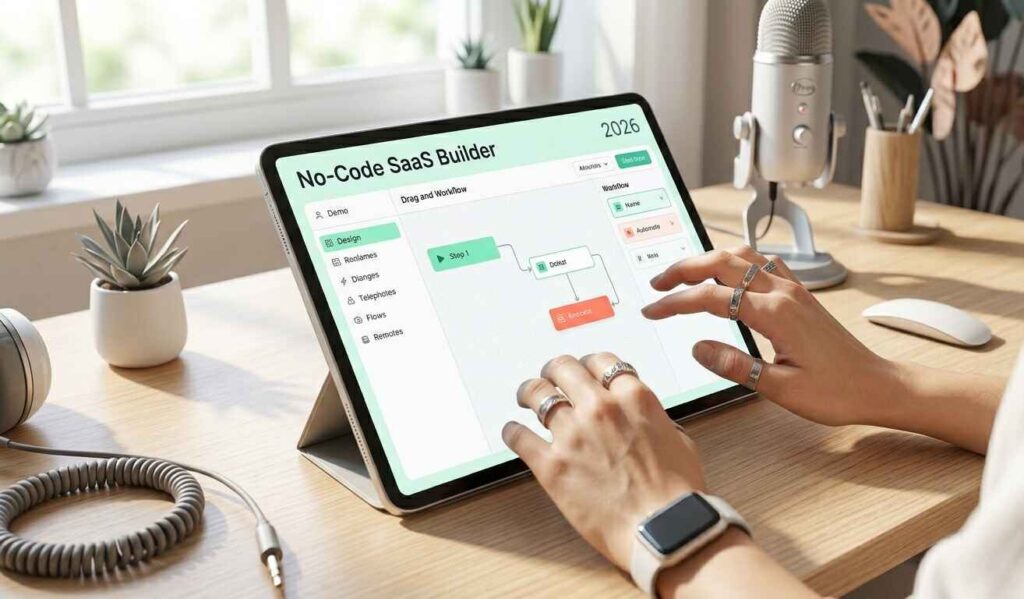
No-code platforms like Bubble, Glide, and Softr have matured a lot. You can now build genuinely useful small web tools without writing a single line of code. And with AI assistance for logic and design decisions, the barrier has dropped even further.
The sweet spot is small, specific tools that solve a single annoying problem. A tax estimation calculator for freelancers. A habit tracker with a specific methodology. A simple client portal template businesses can use. These aren’t trying to be the next big startup — they’re small tools that save people time, and people happily pay $5–$15/month for them.
I’ve seen solo builders charge $7/month for tools with 200–300 paying users. That’s $1,400–$2,100/month from something that took a few weeks to build and runs almost entirely on its own.
The key is finding the right problem. Reddit threads, Twitter/X complaints, Quora questions — these are goldmines for “I wish someone made a tool that…” moments. Find one of those, build the simplest possible version of the solution, and charge for it.
5. Email Newsletter With Curated Sponsorships
This is one of the most underrated plays right now, especially in professional niches.
A newsletter with even 1,000 highly engaged subscribers in a specific industry can command $100–$300 per sponsorship mention. At two to four sponsors per month, you’re looking at $200–$1,200 from a newsletter that might take you three to four hours per week to produce.
What’s working in 2026 is specificity and curation. Nobody needs another general productivity newsletter. But “a weekly newsletter for independent UX designers” or “curated resources for small e-commerce store owners” — those attract a defined audience that sponsors are willing to pay to reach.
Platforms like Beehiiv and Kit (formerly ConvertKit) make the technical side straightforward. Beehiiv in particular has a built-in ad network that connects small newsletters with relevant sponsors, which solves the “how do I find advertisers” problem early on.
Growing the list is the hard part. The best approaches I’ve seen: consistent presence in niche online communities, offering a free lead magnet (a resource, checklist, or mini-guide), and cross-promotion with other small newsletters in complementary niches.
6. Royalty Income From Music and Audio
If you play any instrument or have any music production background, this one is criminally underused.
Platforms like DistroKid, TuneCore, and Musicbed let you upload original music and earn royalties when it’s streamed on Spotify, used in YouTube videos, or licensed for commercial use. Loop packs, ambient soundscapes, background study music, lo-fi beats — all of these have established audiences and steady demand.
You don’t need to be a professional musician. Functional music — the kind people put on while working, studying, or relaxing — has low artistic expectations and high usage volume. I have a friend who produces simple ambient tracks using GarageBand and a MIDI keyboard. He’s uploaded about 60 tracks across various platforms and earns roughly $150–$200/month in streaming royalties with zero ongoing effort.
The setup takes a weekend. The royalties accumulate for years.
The Mistakes I’d Avoid This Time
The biggest one: trying to build too many income streams at once. I did this in my first year and have zero to show for that period. Pick one stream, work it seriously for 90 days, and see if it shows any traction before adding a second.
The second mistake: chasing whatever is being hyped on social media at that moment. Drop shipping had a moment. NFTs had a moment. Certain affiliate niches blow up and then crash. The income streams that last are the ones built on genuine value — content people want to read, products people actually need, tools that solve real problems.
The third: underpricing everything out of fear. A $5 digital product is not significantly more attractive to a buyer than a $15 one, but it earns you three times less. Price based on the value you’re delivering, not on what feels safe.
And finally — the mistake of waiting for the perfect moment. The best time to start any of these was 12 months ago. The second best time is right now. Something that takes six months to start earning means you’re six months away from passive income — but only if you start today.
Where I’d Actually Begin
If I had to pick a first step for someone reading this in 2026, I’d say this: spend one week just identifying which of these you have the most natural advantage in. Are you a writer? The content site or newsletter makes sense. Creative? Digital products or stock content. Tech-comfortable? The no-code tool route. Musical? Audio royalties.
The trap is spending weeks comparing options instead of picking one and starting. Any of these can work. None of them works for someone who’s still planning six months from now.
Pick the one that fits how you already think and spend the next 30 days taking the smallest possible real steps toward it. Not researching. Not planning. Actually building.
That’s genuinely the whole secret.