

Three years ago, I had exactly $47 in my checking account, a laptop that took four minutes to boot up, and a very strong desire to never ask my family for money again.
I didn’t have startup capital. I didn’t have a business degree. I didn’t have a mentor or a network or any of the things people say you need to build something. What I had was time, a skill or two I’d been undervaluing for years, and an internet connection.
That was enough.
I’m not telling you this to set up some dramatic rags-to-riches story. I’m telling you because when I was searching for legitimate ways to earn money online without spending money first, almost every article I found either pushed some paid course or listed ideas so vague they were useless. “Start a dropshipping store!” — okay, but you need money for ads. “Launch an e-commerce brand!” — with what inventory?
So this is the list I wish I’d found back then. Real ideas, zero upfront cost, honest about what each one actually involves.
Why “No Investment” Is Actually Possible Online
The reason these ideas work without money is because the internet lets you sell time, knowledge, and skills directly to people who need them — without a middleman, a storefront, or a warehouse.
You’re not moving physical products. You’re not paying for manufacturing. In most cases, the platforms you need are free to join, and the only thing you’re investing is effort and consistency.
That said, “no money” doesn’t mean “no work.” Anyone who tells you otherwise is trying to sell you something. These paths are real, but they require genuine time and effort, especially at the beginning.
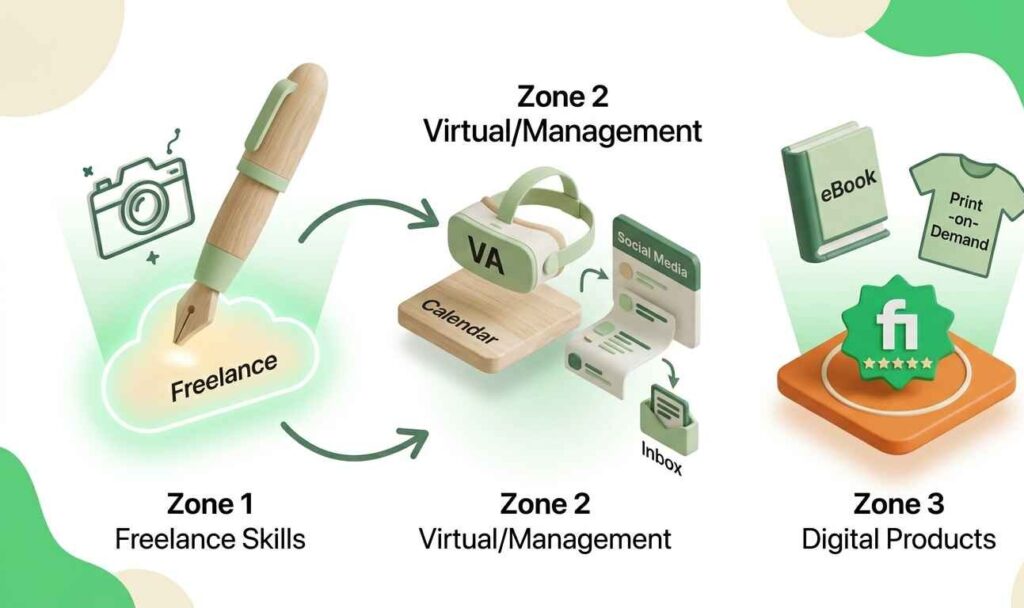
1. Freelance Writing
This was my own starting point, and I still think it’s the most accessible zero-investment business for anyone who can string sentences together clearly.
Every website, blog, newsletter, and brand on the internet needs written content. Most of them don’t have in-house writers. They hire freelancers — people who write articles, product descriptions, email sequences, social media captions, and more on a project or ongoing basis.
You don’t need a portfolio to start. You need a few writing samples, which you can create yourself on topics you know well.
Here’s how I got my first client: I signed up on Upwork, wrote three sample articles on topics I was genuinely knowledgeable about, set a modest rate to be competitive as a newcomer, and applied to about twenty jobs in the first week. I heard back from two. One hired me. That first project paid $75 for 1,000 words, which felt like a miracle at the time.
Within three months I had raised my rates significantly and had regular clients.
Other platforms worth trying: Fiverr (create service packages and let clients find you), ProBlogger job board (tends to have higher-paying gigs but more competition), and cold pitching directly to blogs or businesses in your niche via email.
The one mistake I kept making early on: underpricing myself dramatically. I thought low rates were the path to clients. They’re actually the path to burning out on low-paying work. Set reasonable rates, and put your energy into finding clients who value quality rather than racing to the bottom on price.
2. Freelance Graphic Design
If you have a design eye and know your way around tools like Canva (free), GIMP (free), or even the free tier of Adobe Express, there’s consistent demand for logo design, social media graphics, presentation templates, and brand kits.
Canva especially has become a legitimate professional tool — not just something people use to make birthday cards. Plenty of working designers use it for client work, and plenty of small businesses need someone who can use it well without charging agency rates.
You can post design packages on Fiverr, reach out to small local businesses that clearly need a visual identity upgrade, or browse Upwork for short-term design projects.
The learning curve is real but surmountable with free YouTube tutorials. If you don’t know design yet but want to learn, DesignCourse on YouTube and The Futur channel have enough free content to build a working skill set before you pay for anything.
3. Virtual Assistant Work
This one surprises people because it sounds corporate, but it’s genuinely one of the most accessible online businesses with zero investment needed.
Virtual assistants handle tasks that business owners and entrepreneurs don’t want to do themselves: email management, scheduling, data entry, customer service replies, social media posting, research, travel booking, and more. The skill requirement varies by task, but the barrier to entry on basic VA work is low.
The pay varies too — anywhere from $10/hour for entry-level tasks to $40–$60/hour for specialized VA work (think: someone who manages a CEO’s calendar and communications, or a VA with bookkeeping skills).
Platforms like Belay, Time Etc, and Fancy Hands connect VAs with clients. Upwork is another solid option. Or you can market yourself directly in Facebook groups where entrepreneurs and small business owners hang out — these communities often have people actively posting that they’re looking to hire.
One thing that helps enormously: niching down. “I’m a virtual assistant” is forgettable. “I help e-commerce business owners manage their Shopify store, customer emails, and inventory tracking” is something specific that a specific person will pay for.
4. Social Media Management
Small businesses know they need to be on Instagram, Facebook, LinkedIn, or TikTok. Most of them have no idea how to do it well and no time to figure it out.
That gap is your opportunity.
Social media managers handle content creation, scheduling, engagement, and sometimes ad management for clients. If you’ve spent any real time understanding how content performs on a platform — what kinds of posts get engagement, how to write captions that actually get clicks, how to use hashtags effectively — that knowledge has market value.
You don’t need expensive tools to start. Meta Business Suite (free), Buffer’s free plan, and Later’s free tier are enough to manage a few clients’ accounts while you’re getting started.
To get your first client, approach someone you already know — a local restaurant, a boutique, a small service business — and offer to manage their social presence for a month at a reduced rate in exchange for a testimonial. That testimonial becomes the proof you need to charge full rates for the next client.
The rate for social media management ranges from $300–$500/month per client for basic management on one or two platforms, up to $1,500–$3,000/month for comprehensive multi-platform strategies. Three clients at even the lower end is a real income.

5. Online Tutoring or Teaching
Whatever you know how to do well, there are people who want to learn it and are willing to pay for that knowledge.
This doesn’t mean you need to be a certified teacher or a world-class expert. You need to be meaningfully ahead of the person you’re teaching — and able to explain things clearly.
Tutoring subjects like math, English, science, or test prep (SAT, IELTS, GRE) has strong demand year-round. Platforms like Tutor.com, Wyzant, and Preply connect tutors with students and handle the payment processing, though they take a commission.
For more creative or professional skills — cooking, a musical instrument, a software tool, a language — you can offer one-on-one sessions through Zoom and market yourself on social media or through word of mouth.
I know someone who started teaching Urdu to diaspora families who wanted their children to learn the language. She charged a modest hourly rate, ran classes over Zoom, and built a steady waiting list purely through referrals within six months. Zero advertising budget. Just a specific skill meeting a specific need.
6. Blogging (With a Long-Term Mindset)
I’ll be upfront: blogging is on this list, but it’s the slowest of these options to generate income. If you need money in the next two weeks, start with freelancing first.
That said, blogging is genuinely free to start and genuinely does make money once it gains traction. Platforms like Blogger.com and WordPress.com offer completely free hosting to get started. Later, a basic domain and hosting runs around $3–$5/month, which I’d argue crosses into investment territory — but the beginning costs nothing.
The income potential through display advertising, affiliate marketing, and digital products is real and well-documented. It just takes time. Think six to eighteen months before you see meaningful numbers, and that’s with consistent effort.
The reason I include it here: blogging is one of the few online businesses where you can build a long-term passive income asset without any initial capital. The investment is entirely in time and consistency.
7. Dropshipping Via Print-on-Demand
Traditional dropshipping usually requires ad spend, which costs money. Print-on-demand is different.
Platforms like Printful, Printify, and Redbubble let you create designs for T-shirts, mugs, phone cases, tote bags, and other products. When someone buys, the platform prints and ships — and you earn the margin between the base cost and your selling price. You never hold inventory and you never pay upfront for products.
This is genuinely a zero-cost-to-start model if you use Redbubble as your storefront (they have a built-in marketplace) or connect Printful to a free Etsy shop.
The caveat: it’s competitive, and without any marketing budget, growth is slow. The people who do well in print-on-demand either have a strong design sense, a niche audience that connects with their designs, or both.
But for someone who enjoys design and wants to build something passive over time, the zero-upfront-cost structure makes it worth including here.
8. Selling Skills on Fiverr
Fiverr deserves its own mention because it’s specifically built around the idea of packaging a skill as a service and letting buyers come to you.
Whatever you’re good at — writing, translation, video editing, data entry, voiceover work, research, Excel spreadsheets, creating PowerPoint presentations, proofreading — there’s likely a category for it on Fiverr, and people are actively searching for it.
Creating a seller profile and listing your first “gig” is free. The platform takes 20% of each sale, which is the trade-off for the built-in traffic.
The key to getting traction on Fiverr is niche-specific gig titles and genuinely strong sample work shown in your gig gallery. Vague gigs with no portfolio examples get ignored. Specific gigs with clear deliverables and visible sample work get clicks.
The Mistakes That Slow People Down
Trying to do everything at once. Pick one of these, commit to it for sixty days, and measure what happens before adding another income stream.
Waiting until you feel “ready.” You will not feel ready. Nobody does. The first client is awkward. The first blog post feels vulnerable. The first Fiverr gig feels amateur. Do it anyway.
Choosing based on what sounds impressive rather than what matches your actual skills. If you hate writing, freelance writing will be miserable. If you have no design instinct, graphic design will be a constant fight. Go with what you’re already decent at and build from there.
Giving up at week three when nothing has happened yet. These businesses almost universally take longer to get momentum than people expect. Freelancers often don’t land their first client for two to four weeks of active pitching. Blogs take months. Print-on-demand can take ages without marketing. Consistency is doing the work when it doesn’t appear to be working yet.
How to Actually Pick One and Start Today
Here’s a genuinely simple way to decide: write down the three skills or topics people in your life have come to you for help with. It doesn’t matter if they feel small or obvious to you — your normal is someone else’s hard problem.
Then look at that list and ask: which of these could I package as a service or piece of content that someone would pay for?
Whatever the answer is, that’s your starting point.
Sign up on one platform today. Create your profile or write your first piece. Don’t spend the next week researching and optimizing and watching YouTube videos about what you’re about to do — that’s just procrastination with extra steps.
The entire advantage of zero-investment businesses is that the cost of starting is nothing. The cost of not starting is time you don’t get back.
Start small, stay consistent, and adjust as you learn what’s working. That’s genuinely the whole framework.