

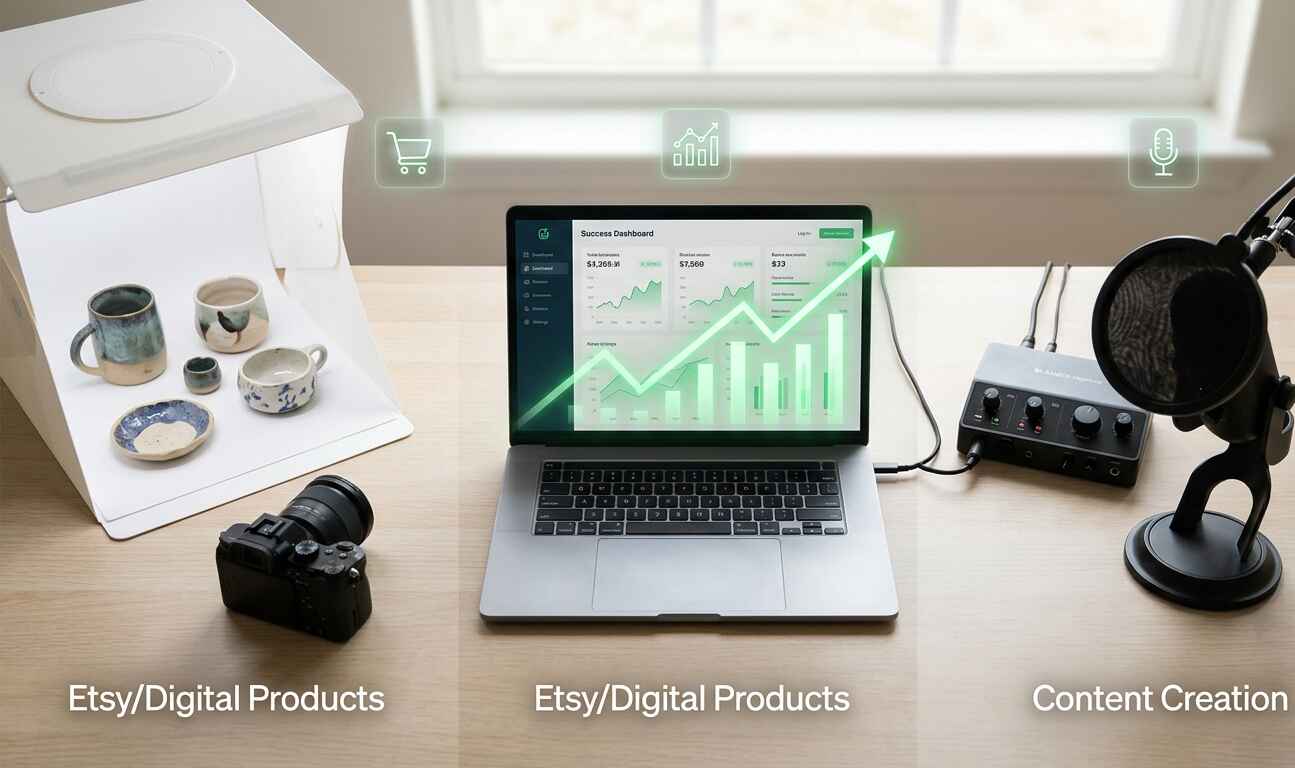
When my neighbor knocked on my door two summers ago, I thought she was going to complain about my dog.
Instead, she asked if I could help her figure out why her Etsy shop wasn’t making sales. She had been hand-making candles in her kitchen for years — beautiful ones, the kind people gave as gifts — and she had listed about thirty of them online with almost nothing to show for it.
We sat at her kitchen table for two hours. I looked at her photos (too dark), her product descriptions (too vague), her pricing (too low, ironically), and her shop branding (nonexistent). Six weeks after we made changes, she had her first $1,100 month. She hadn’t moved from her house. She hadn’t spent money on equipment she didn’t already have. She had just started running what she already loved doing like an actual small business.
That conversation stuck with me. Because what she had built — slowly, without really trying to — was exactly the kind of home-based online business that people search for and rarely find real guidance on. Not a get-rich scheme. Not a passive income fantasy. A small, real business that fits inside a regular life and generates meaningful income.
Here are the ones that actually work.
What Makes a Home Business Worth Pursuing
Before diving in, it’s worth being honest about what “small online business” actually means in practice.
Some of these ideas have a low ceiling — they’ll earn you a steady side income but probably won’t replace a full-time salary on their own. Others have a higher ceiling but require more time investment before they pay off. A few can genuinely become a primary income source given enough time and consistency.
The ones worth pursuing share a few qualities: they have real market demand, they match something you’re already decent at, the startup costs are minimal, and you can run them around a normal schedule without needing a separate office or staff.
With that framing, let’s get into it.
1. Handmade or Curated Product Sales on Etsy
My neighbor’s story above is a perfect example of this one, and it’s far from unique.
Etsy has built an enormous marketplace for handmade goods, vintage items, craft supplies, and digital downloads. What works on the platform has shifted over the years — it’s more competitive now than it was a decade ago — but the opportunity is genuinely still there for people who approach it with intention.
What sells consistently: candles, soap, personalized jewelry, hand-lettered prints, custom home décor, wedding-related items, baby products, and seasonal goods. The throughline is that these are things people want that feel personal, unique, or better quality than what they’d find on Amazon.
The difference between Etsy shops that make money and ones that don’t almost always comes down to three things: photography, SEO-optimized titles and descriptions, and understanding what buyers actually search for versus what sellers think buyers want.
For photography: you don’t need a professional camera. You need natural light, a clean background, and multiple angles. A smartphone camera in good lighting will outperform a DSLR in a dark corner every single time.
For SEO: use Etsy’s own search bar to see what autocompletes when you start typing your product category. Those autocomplete suggestions are real search terms buyers are using. Build your titles and tags around them rather than around what you’d call the product yourself.
Tools worth knowing: Marmalead and eRank both analyze Etsy search data and help you find high-traffic, lower-competition keywords. Both have free tiers that are useful enough to start.
2. Freelance Service Business
This is the single most accessible home-based online business for most people, because it starts with skills you already have.
Freelancing means offering a specific service to clients on a project or retainer basis — writing, graphic design, web development, bookkeeping, copyediting, translation, virtual assistance, video editing, social media management, and dozens of other categories.
The home-based angle is genuinely seamless here. Every piece of client communication happens over email and Slack. Every deliverable gets handed over digitally. You can manage three clients from your kitchen table and none of them will ever know or care where your office is.
What I’ve seen work for people starting from scratch: pick one service, one platform, and one client category. Not three services across five platforms targeting everyone. One thing, clearly packaged, pointed at a specific kind of client.
“I write blog content for B2B software companies” is a positioning statement that gets hired. “I’m a freelance writer who can do many things” does not.
For finding clients: Upwork and Fiverr are the obvious starting points because they have built-in buyer traffic. LinkedIn is underutilized for freelance outreach — a well-optimized profile and some consistent posting in your area of expertise can attract inbound inquiries without any platform fees. Contra is worth knowing as a newer platform that charges no commission, meaning you keep 100% of what clients pay.
The growth path here is real. Many people start freelancing as a side income from home and gradually build it to full-time — not by working more hours but by raising rates, getting better clients, and eventually adding retainer relationships that provide predictable monthly income.
3. Online Tutoring or Coaching
The internet has made geographic location almost irrelevant for teaching and coaching. Whether you’re helping a high school student in another state pass their math exam or coaching a professional through a career transition, the session happens over Zoom and the payment happens through Stripe or PayPal.
Tutoring has the clearest market for people with academic backgrounds or subject expertise. Platforms like Wyzant, Tutor.com, and Preply handle client acquisition and payment processing in exchange for a commission. Or you can go direct — build a simple Calendly booking page, set your rate, and market yourself through social media or word of mouth, keeping all the revenue yourself.
Coaching is broader. Life coaching, career coaching, business coaching, fitness coaching, nutrition coaching, relationship coaching — if you have a track record of results in an area and can help someone else navigate it, there’s a market. The credibility question matters more here than in tutoring: coaching clients are paying for transformation and they want to trust that you’ve either been where they are or have helped others get to where they want to go.
A specific niche I’ve seen do well from home: executive communication coaching for non-native English speakers preparing for corporate roles. High-value clients, specific problem, premium rates, entirely conducted over video calls.
4. Blogging or Content Publishing
This one has the longest ramp-up of anything on this list, but it also has a ceiling that most service businesses don’t.
A blog that reaches meaningful traffic can earn through display advertising, affiliate marketing, sponsored content, and digital product sales — often simultaneously. The income doesn’t require your active hours once the content is published and ranking, which creates genuine passive earning potential over time.
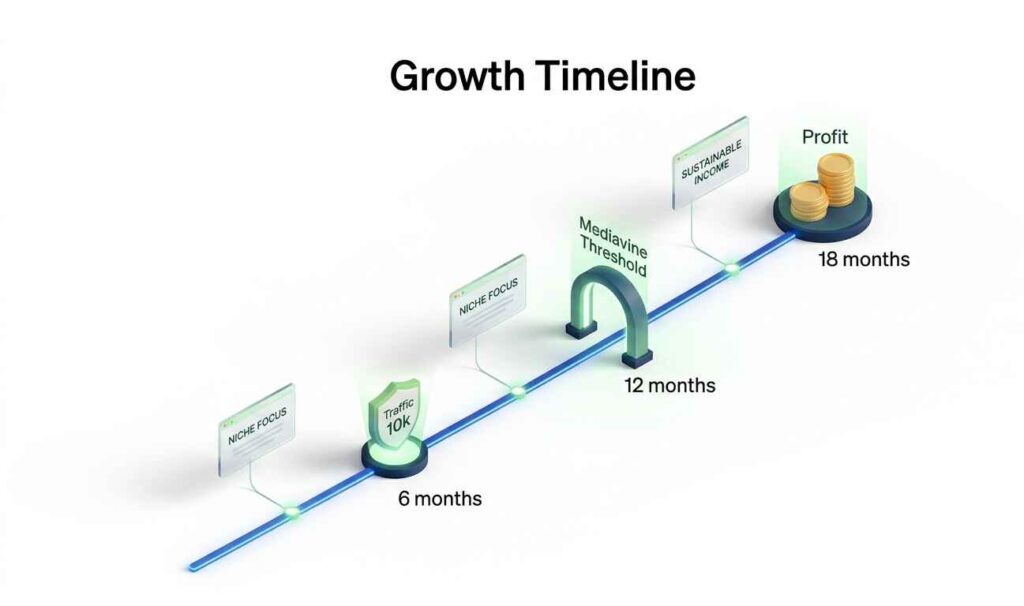
The honest reality: it typically takes six to eighteen months of consistent publishing before a blog earns meaningfully. This is not a short-term income solution. It’s a long-term asset-building strategy that, if you stick with it, can eventually pay you while you sleep.
What works in 2026: niche focus, SEO-driven content planning, and an email list built from day one. Generic lifestyle blogs rarely gain traction. A blog about “budget meal prep for people with chronic illness” or “home workshop projects for small spaces” — something specific — has a defined audience and clear search demand to target.
Free platforms to start: WordPress.com, Blogger. For more control and monetization options, a self-hosted WordPress site with hosting through Hostinger or SiteGround costs around $3–$5 per month, which is about as low as real business expenses get.
For ad monetization once traffic grows: Mediavine requires 50,000 monthly sessions; Raptive requires 100,000 pageviews. Both pay significantly better than Google AdSense. Working toward those thresholds is a legitimate medium-term goal.
5. Selling Digital Products
Once you’ve created a digital product, every sale after that is nearly pure profit. No inventory. No shipping. No manufacturing cost. Just a file that delivers value and sells while you’re living your life.
The category is broad: eBooks, templates, printables, Notion dashboards, Excel spreadsheets, Lightroom presets, music samples, fonts, sewing patterns, lesson plans, resume templates, meal plans, financial trackers. Whatever you know how to make well that someone else would pay to have.
Where to sell: Gumroad and Lemon Squeezy are the cleanest options for straightforward digital downloads. Etsy has a dedicated digital products marketplace with huge built-in traffic. Your own website gives you full margin but requires you to drive your own traffic.
The key insight most people miss: the product doesn’t have to be elaborate or expensive to sell well. A well-designed, genuinely useful $9 template that solves a specific frustration will outsell a bloated $97 “ultimate guide” that tries to be everything to everyone. Small, focused, specific.
I know a woman who makes a consistent few hundred dollars a month selling a single Canva template pack for small fitness studios. She made it in a weekend, listed it on Etsy, and it sells on its own. That’s the model in its simplest form.
6. Print-on-Demand Store
This sits at the intersection of creativity and e-commerce without the inventory risk of either.
Print-on-demand services like Printful, Printify, and Redbubble let you upload designs that get printed on T-shirts, hoodies, mugs, tote bags, phone cases, and other products when orders come in. You set your selling price above the base cost, and the difference is your profit. You never touch the products.
Running this from home means designing from your laptop, uploading to your storefront, and letting the fulfillment happen automatically. Redbubble has a built-in marketplace where buyers already browse, which means organic discovery without building your own traffic. Connecting Printful to an Etsy shop or Shopify store gives you more control over branding and pricing.
The realistic challenge: this is a design-dependent business. If you can create distinctive, appealing designs — not generic text on shirts but something people specifically seek out — it can build into a real income stream. If design isn’t your strength, the products look generic and don’t sell.
Niche-focused print-on-demand tends to outperform general stores. A store of designs specifically for nurses, or for left-handed people, or for people who love a specific obscure hobby, finds its audience more easily than a store with random designs across every category.

7. Virtual Bookkeeping
This one flies under the radar in most “home business” articles, but it’s worth knowing about.
Small businesses desperately need bookkeeping help and frequently don’t have the budget or the need for a full-time accountant. A virtual bookkeeper handles recording transactions, reconciling accounts, managing invoices, and preparing reports — all done remotely through software like QuickBooks Online or Xero.
You don’t need to be a CPA to do bookkeeping. A basic understanding of accounting principles, proficiency with bookkeeping software, and attention to detail are the core requirements. Courses on platforms like Coursera, LinkedIn Learning, or Ben Robinson’s Bookkeeper Launch program can build the skill set from scratch.
Rates for virtual bookkeepers typically start around $25–$40 per hour and go up significantly with experience and specialization. A bookkeeper with four steady monthly clients can earn a full-time equivalent income in part-time hours. It’s one of the higher-paying home-based services available to someone without a specialized degree.
8. YouTube Channel or Podcast
Building an audience through long-form content is slower than service work but creates compound value over time in ways that hourly services don’t.
A YouTube channel monetizes through AdSense (once you hit 1,000 subscribers and 4,000 watch hours for the YouTube Partner Program), affiliate links, sponsorships, and products. A podcast monetizes through sponsorships, listener support platforms like Patreon, and affiliate marketing.
Neither of these pays much at the start. Both require consistency for six to twelve months before they generate meaningful income. But the people who stick with them often find that a mid-sized audience in a specific niche earns more than a large generic one — because engaged niche audiences buy what their trusted creator recommends.
For YouTube specifically: you don’t need expensive equipment to start. A decent USB microphone (the Audio-Technica ATR2100 or Blue Snowball are both under $70) and decent natural light matter far more than camera quality at the beginning. Content quality and consistency is what builds channels — not production value.
Mistakes That Hold Home Business Owners Back
Trying to serve everyone. The businesses that struggle most are the ones afraid to narrow their focus. “I can help any kind of client” sounds flexible; to clients it sounds unfocused. The ones that grow fastest know exactly who they’re for.
Underpricing as a permanent strategy. Charging low rates to attract clients is fine as a short-term tactic to build a portfolio. It becomes a trap when it’s never adjusted. Underpriced services attract clients who value price above everything else — and those clients are usually the most demanding and least loyal.
Treating “home business” as “hobby with occasional income.” The businesses that succeed treat themselves as businesses: they have set working hours, they track income and expenses, they invest in tools that improve output quality, they follow up with clients professionally. The home location is about convenience, not about lowering standards.
Waiting until everything is perfect to launch. A mediocre Etsy listing that’s live is infinitely more useful than a perfect one still being drafted. A Fiverr profile that needs work but exists can get clicks. A blog with ten posts teaches you things that research never will. Launch imperfectly. Fix it as you go.
Not separating personal and business finances from the start. Even if you’re making $200 a month, open a separate bank account for business income and expenses. It makes tax time coherent and helps you actually see how the business is performing.
Picking One and Making It Real
Here’s the honest version of how most successful home-based businesses start: someone does one thing, consistently, for a few months — and adjustments happen based on what actually works rather than what they planned in advance.
The planning stage feels productive. The doing stage is where the business actually becomes real.
Look at this list and ask yourself which idea requires the least learning before you could make your first dollar. Not the most exciting one, not the one with the highest theoretical ceiling — the one you could meaningfully start this week with what you already have.
That’s your starting point. Everything else gets added later.
The kitchen table, the spare bedroom, the corner of the living room — these are perfectly adequate headquarters for businesses that can, with enough time and effort, grow into something genuinely significant.
The only thing that separates the people who build them from the people who don’t is whether they start.