

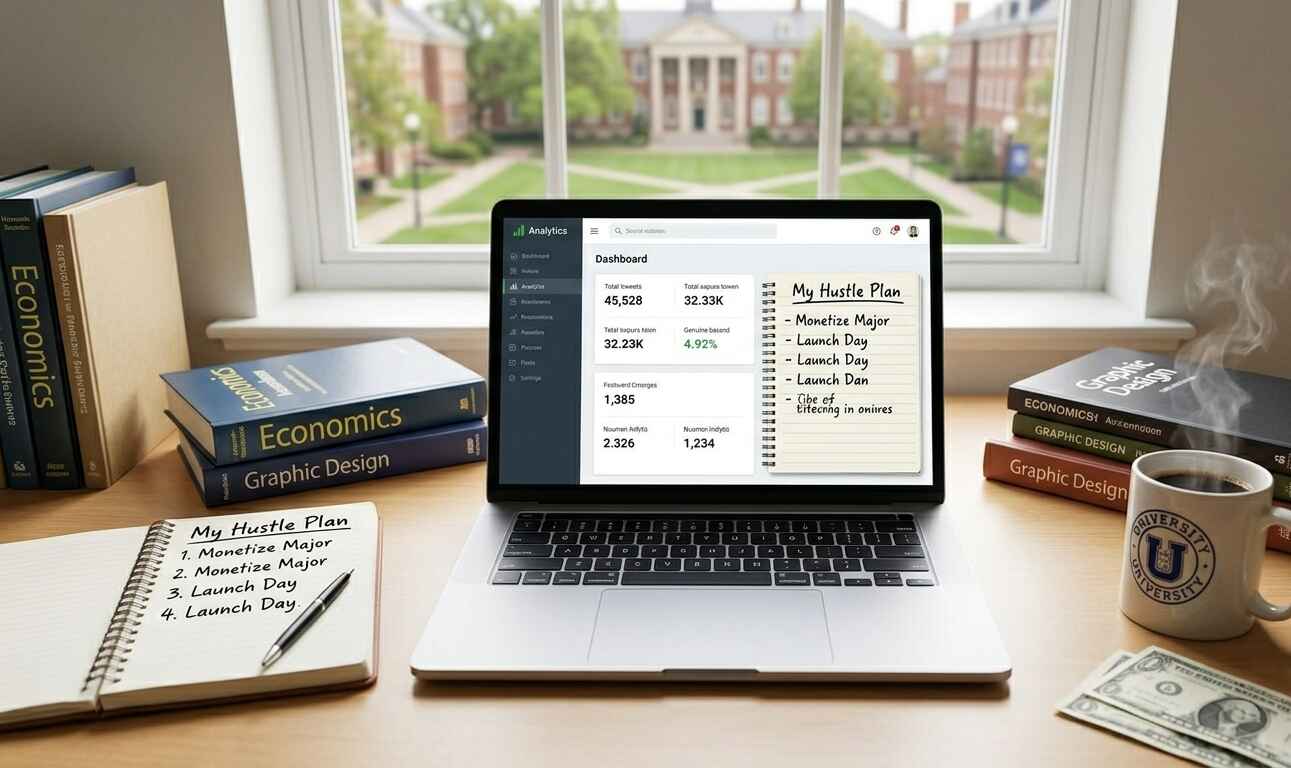
My junior year of university, I was surviving on instant noodles four nights a week — not because I was particularly busy, but because my part-time job at a café paid just enough to cover textbooks and not quite enough to also cover groceries.
A friend of mine was in the same course load, the same financial situation, same age, same everything — except he had started doing freelance video editing for small YouTube channels in his spare time. By the end of that semester, he was making more from his laptop in ten hours a week than I was making behind a coffee machine in thirty.
That gap genuinely changed how I thought about time and earning potential as a student. It wasn’t that he was smarter or more talented than me. He had just figured out something I hadn’t yet: there’s a category of work where being a student is not a disadvantage. You have specific skills, you have flexible hours, and you have access to technology that makes starting almost anything embarrassingly easy.
This is the list of ideas that actually make sense for students — financially realistic, time-flexible, and based on skills most students already have or can build without spending money first.
Why “Student” Is Actually an Advantage Here
Before the list, this is worth saying out loud: a lot of online business guides are written for people with full-time hours, startup capital, and no class schedule to work around.
Students have different constraints — and also different advantages that rarely get mentioned.
You’re surrounded by people with problems you know exactly how to solve. Your classmates need tutoring, editing, design work, and tech help. Your professors and university departments sometimes need research assistants. Local businesses near campus want to reach student audiences. These are warm markets sitting right next to you.
You also have something valuable that most working adults are chronically short on: comfort with new tools. The average student moves through new apps, platforms, and software faster than most professionals. That adaptability is an actual competitive asset in digital work.
The ideas below are ranked roughly from easiest-to-start to slightly-more-involved, but there’s no single right answer. Pick what aligns with what you already know.

1. Tutoring — The Most Underrated Student Income Stream
If you’re strong in any subject — math, sciences, languages, economics, writing, coding, test prep — there are students at your level and below who are willing to pay to understand what comes naturally to you.
This is one of the cleanest business models available to students because it requires zero upfront cost, leverages knowledge you already have, and the client base is literally surrounding you every day.
Online tutoring in particular has expanded the market dramatically. You’re no longer limited to students on your campus. Platforms like Wyzant, Preply, Tutor.com, and Superprof connect tutors with students globally. Wyzant lets you set your own hourly rate and keeps 25% once you’ve built a track record with clients. Rates for university-level subject tutoring run anywhere from $20–$70 per hour depending on subject complexity and your experience.
For test prep specifically — SAT, ACT, GRE, GMAT, IELTS, TOEFL — demand is consistent and rates tend to be higher because the stakes feel higher to students paying for it.
The fastest path to your first client: post in your university’s Facebook group, Reddit community, or campus Discord that you’re offering tutoring sessions. Word of mouth from one satisfied student can fill a schedule faster than any platform algorithm.
One thing I’d suggest: don’t undersell yourself because you’re a student. You don’t need a teaching degree to tutor. You need to explain the material clearly and actually help someone understand it. If you can do that, you’ve earned the rate.
2. Freelance Writing and Content Creation
Every blog, newsletter, business website, and brand on the internet runs on written content. The demand doesn’t slow down, and the market for freelance writers who can deliver clear, well-researched work is consistently strong.
As a student, you’re likely writing more than most people realize — essays, reports, research summaries, case studies. That writing practice translates directly to freelance content work with a small adjustment in style.
Where to start: Upwork and Fiverr are the two most accessible platforms for finding clients as a beginner. On Fiverr, you create a listing describing what you offer, set a price, and clients come to you. On Upwork, you browse open projects and send proposals. Both have learning curves, but both have real paying clients.
The types of writing that pay consistently well: SEO blog posts for small businesses, product descriptions for e-commerce stores, email newsletter content, LinkedIn articles, and social media caption writing.
A student majoring in anything has niche writing advantages they don’t always recognize. A finance student writing for fintech blogs, a nutrition student writing for health brands, a law student writing for legal services websites — these are all credible specializations that clients specifically seek out and pay more for than generic writing.
Build three to five sample pieces on topics you know well. Put them in a Google Doc or a free portfolio site like Journo Portfolio or Contently. That’s your portfolio. That’s all you need to start.
3. Social Media Management for Small Businesses
This one is wildly accessible for students who spend any time on social platforms — which is most students.
Small businesses — local restaurants, boutiques, fitness studios, salons, startups — know they need a social media presence but frequently have no time or skill to manage it consistently. They need someone who understands how the platforms work, can create or organize content, write captions, schedule posts, and track basic engagement.
That person can be you.
The practical reality is that growing up using Instagram, TikTok, and Twitter gives you an intuitive understanding of platform behavior that many small business owners in their thirties and forties genuinely don’t have. That’s not a small thing. It’s a real skill with market value.
Tools you’ll use: Buffer, Later, or Metricool for scheduling posts across platforms — all have free plans sufficient for managing one or two clients. Canva for creating graphics (the free version is genuinely powerful). Meta Business Suite for managing Facebook and Instagram together.
To get your first client, start local. Walk around campus and nearby streets and notice which small businesses have weak or inactive social media. A café with 200 Instagram followers and the last post from four months ago is a potential client. Approach them directly — in person or via a brief email — and offer a one-month trial for a reduced rate in exchange for a testimonial.
Once you have one case study showing results, charging $300–$600 per month per client for basic management becomes a very achievable conversation.
4. Graphic Design and Visual Content
If you have any design sensibility and have spent time with Canva or want to learn it, there is consistent demand for logo design, social media graphics, pitch deck design, resume design, infographics, and branded templates.
Canva’s free tier is genuinely capable. For more advanced work, Adobe Illustrator and Photoshop are available at discounted student rates through the Creative Cloud student plan. Many universities also provide Adobe suite access for free through computer labs or student software portals — worth checking before paying for anything.
Students at design, art, or communications programs have an obvious head start here. But plenty of self-taught designers are doing real client work based purely on a good eye and practice.
Fiverr is particularly well-suited for design services because the work is visual and portfolios do the selling. A clean Fiverr profile with strong sample designs in your gig gallery can start generating inquiries without any active pitching.
The niche that’s particularly accessible for students: presentation and pitch deck design. Startups, business school students, professionals preparing investor presentations — they all need slides that look polished, and it’s a skill that translates directly from the presentation assignments most students are already doing.
5. Selling Digital Products
This one is different from the others because it scales without requiring more of your time as sales grow. You create something once and sell it repeatedly.
For students, the most natural digital products to create are things directly tied to academic life: organized notes from courses (Gumroad and Etsy both host student note sellers with genuine followings), study guides for specific exams, Notion templates for student productivity, resume templates, cover letter frameworks, and subject-specific reference sheets.
Notion templates in particular have become a surprisingly viable product category. A well-designed Notion dashboard for university students — tracking assignments, deadlines, study schedules, and reading lists — can sell on Gumroad or Etsy for $5–$20 and accumulate sales consistently once it’s listed.
This requires more upfront effort than selling a service, because you have to build the product before you earn anything. But the payoff is that it earns while you’re in class, sleeping, or on break. It’s genuinely passive income in a way that service work isn’t.
The honest timeline: don’t expect immediate sales. It takes time to get discovered organically on Etsy or Gumroad. Either invest in some social media promotion or be patient while the product accumulates search visibility. Most people who successfully sell digital products on these platforms have multiple products listed, not just one.
6. Freelance Video Editing
This is what my university friend was doing — and it’s still one of the more lucrative student-accessible freelance skills going into 2026.
The explosion of YouTube channels, podcasts with video components, TikTok creators, and branded video content means demand for editors who can turn raw footage into polished content is consistently high.
Free and low-cost software options: DaVinci Resolve is free and professional-grade — it’s used in actual film production and it doesn’t watermark exports on the free tier. CapCut is free and particularly popular for short-form content editing. iMovie works fine for basic editing on Mac. Adobe Premiere Pro has a student discount through the Creative Cloud plan.
The learning curve for basic editing is manageable with YouTube tutorials. Channels like Casey Faris and Justin Odisho have free training that can take you from zero to functional within a few weeks of practice.
The market: YouTube creators who lack time to edit their own content, small businesses running video ads, real estate agents who shoot property walkthroughs, university departments making promotional content. All of these are real clients with recurring needs.
Start by offering to edit for free or at a deep discount for one client in exchange for the footage to use as portfolio work. That sample reel is what gets you paid clients.
7. Affiliate Marketing Through a Blog or Social Platform
If you’re willing to play a longer game, building a content platform — a blog, a YouTube channel, a TikTok account — around a topic you know well can generate affiliate income that grows over time.
Affiliate marketing means recommending products or services through unique tracking links and earning a commission when your audience buys through those links. Amazon Associates, for example, pays commissions on almost anything sold through Amazon. Software companies often pay 20–40% recurring commissions. Financial products and services pay high flat fees per conversion.
As a student, the most natural content angles are ones tied to student life: study techniques, budgeting as a student, tech gear for university, fitness on a student budget, learning a new skill, career preparation for your specific field. These are topics with genuine search demand from a clearly defined audience.
The realistic caveat: affiliate marketing through content takes time to build traction. A blog needs search traffic before it earns meaningfully from ads or affiliates. A YouTube channel needs subscribers. Plan for six to twelve months of consistent content before income becomes significant. This is better treated as a long-term asset you build alongside other faster-earning work, not a primary income source at the start.

Mistakes Students Make That Slow Everything Down
Waiting for the “perfect time” to start. There is no semester where you’ll have more free time than you think you need. The students who build something online do it in the pockets of time between lectures and assignments, not during some imagined free period that never arrives.
Picking what sounds impressive instead of what matches their actual skills. Starting a YouTube channel because it seems exciting when you’ve never enjoyed being on camera leads to three videos and abandonment. Start with what you’re genuinely good at right now.
Pricing too low because they feel unqualified as students. Your age doesn’t determine the value of your work. The outcome you create for a client determines the value. If your tutoring helps someone pass an exam they were failing, that’s worth real money. Price accordingly.
Trying to do multiple things at once before any of them are working. Pick one, give it sixty to ninety days of real effort, and measure what happens. Scattered effort across five ideas simultaneously usually means five things that never gain momentum.
Ignoring the platforms and communities they already have access to. Your campus Facebook group, student Discord, university job board, and department WhatsApp groups are warm audiences that most students never think to use for business purposes.
How to Actually Start This Week
Pick one idea from this list — specifically the one where you already have the skill, not the one that requires the most learning before starting.
Spend a maximum of two hours setting up: a free Fiverr or Upwork profile, a simple portfolio on Google Docs, or a post in your campus community offering your service. Two hours. Not two weeks.
Then tell five people. A classmate, someone in a relevant Facebook group, a local business you’ve thought about approaching. Five real conversations or posts, not just a profile sitting waiting to be discovered.
The students I know who built real income streams online weren’t exceptional. They just started doing something small and kept adjusting based on what happened. That’s the whole playbook.
You have the same hours as everyone else. The question is just what you’re doing with the ones that aren’t already accounted for.