

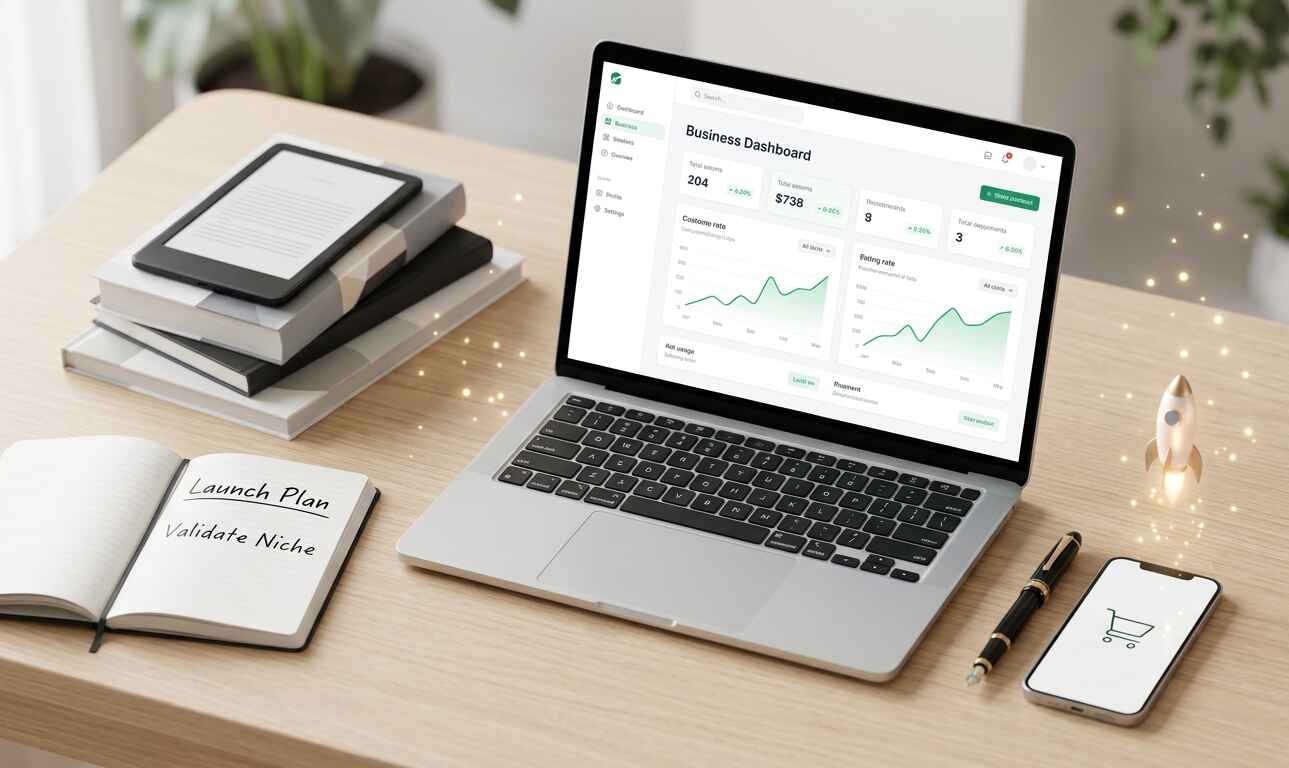
The first digital product I ever made took me eleven days to finish and earned me $27 in its first month.
I was convinced I had wasted nearly two weeks of evenings and weekends. I almost deleted the listing entirely.
I didn’t. And over the following eight months, that same product — a 34-page eBook I had written about managing freelance client relationships — quietly sold 340 more copies without me touching it again. I updated the cover once, tweaked the description twice, and otherwise left it completely alone.
That experience taught me something that took embarrassingly long to sink in: digital products don’t earn fast. They earn repeatedly. That difference changes everything about how you should think about building this kind of business.
If you’ve been circling the idea of selling eBooks, templates, digital planners, guides, or any other downloadable product — and wondering whether it’s worth the effort — this is the honest breakdown of how it actually works and how to start without wasting months going in the wrong direction.
Why Digital Products Are Worth Building
Let me start with the economics, because they’re genuinely unusual compared to most ways of earning money.
When you sell a service — tutoring, writing, design, consulting — you earn once per hour of work. When someone books your time, you show up, deliver, and get paid. Then it’s over and you need another client to earn again.
When you sell a digital product, you do the work once and the product sells indefinitely. There’s no inventory to restock, no fulfillment to manage, no per-unit cost that scales with sales volume. Your cost of goods on the hundredth sale is exactly the same as the first sale — which is approximately nothing.
The catch, and it’s a real one, is that digital products don’t earn much in the first week. The business model rewards patience and volume over time. If you need money urgently, freelancing is faster. If you want to build something that earns while you’re asleep, digital products are worth the slow start.
Step 1: Figure Out What You Actually Know
This is the step most people rush past, and it’s the most important one.
The best digital products aren’t made by people who went looking for a profitable topic and reverse-engineered something to fit it. They’re made by people who noticed a gap — something they struggled to find, a question their audience kept asking, a process they had figured out that others clearly hadn’t.
Start here: what do people come to you for help with? Think about conversations you’ve had where someone said “wait, how did you do that?” or “can you explain that to me?” Think about skills you use so automatically that you forget not everyone has them.
Those moments are pointing at knowledge other people would pay to have packaged clearly.
If nothing comes to mind immediately, a more systematic approach: write down every skill or area of knowledge you have — professionally, academically, from hobbies, from personal experience. Then ask which of those are subjects people actively search for help with. Cross-reference those two lists and you’ll find your starting point.
A few real examples of products built from personal experience that I’ve seen work: a budget travel planner created by someone who had spent years traveling on minimal money, a client onboarding template pack built by a freelance designer who was tired of recreating the same documents for every new client, a sleep training guide written by a pediatric nurse who answered the same parent questions every day at work. None of these required a PhD or a decade of formal credentials. They required genuine, practical knowledge and the willingness to organize it helpfully.
Step 2: Validate Before You Build
This is the lesson that saves months of wasted effort.
The instinct is to build the product first, then try to sell it. The smarter path is to confirm that people want the product before you spend significant time creating it.
Validation doesn’t need to be complicated. It can be as simple as posting a question in a relevant Facebook group or Reddit community: “Would anyone be interested in a guide that explains X?” — and seeing how people respond. A thread with fifteen replies saying “yes, I’ve been looking for this” is meaningful signal. Silence is also meaningful signal.
Another approach: look at what’s already selling in your product category on Etsy or Gumroad. If similar products exist and have reviews, that confirms demand. You’re not looking for an untouched market — you’re looking for proof that people buy in this category, then figuring out how you can make something better or more specific than what’s already there.
Pre-selling is the strongest validation. Create a simple landing page describing what the product will include, set up a payment link through Gumroad or Lemon Squeezy, and share it before the product is finished. If people buy in advance, you have confirmed demand with real money. If nobody buys, you’ve saved yourself the time of building something without a market.
This feels counterintuitive. It also prevents the single most common mistake in the digital product space: building something for months that nobody wanted.
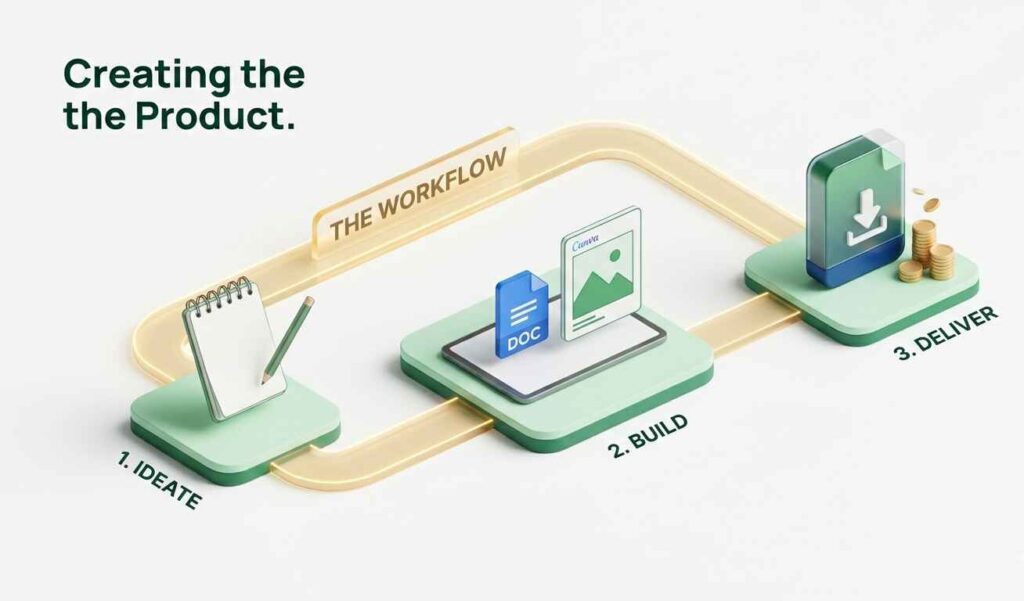
Step 3: Create the Product
Here’s where most first-timers overthink everything.
The product does not need to be long to be valuable. It needs to be useful, clear, and specific. A focused 20-page eBook that solves one problem completely is more valuable to a buyer than an 80-page document that covers a broad topic shallowly.
For eBooks and written guides, the tools I use and recommend: Google Docs for writing (free, collaborative, accessible anywhere), Canva for designing the final PDF layout (the free tier handles this perfectly well — there are professional eBook templates built in), and finally exporting as a PDF that opens cleanly on any device.
Canva specifically has transformed eBook production for non-designers. You don’t need to know anything about InDesign or document layout. You pick a template that fits your tone, paste your content in, adjust the colors and fonts to feel consistent, and export. The result looks professional without requiring professional design skills.
For templates — whether Notion dashboards, Google Sheets trackers, Canva design templates, or PowerPoint/Keynote frameworks — the creation process is more about functionality than writing. You’re building something that works, not something you read.
A few principles that improve any template product: include instructions (a short guide or video walkthrough explaining how to use the template reduces refund requests dramatically), test it with someone who wasn’t involved in building it (their confusion shows you what to clarify), and make it genuinely editable for the buyer rather than locked down in a way that makes it frustrating to customize.
For anything involving design — covers, layout, graphics — Canva handles the vast majority of what you need. Adobe Express has a free tier worth knowing. If you want more control over typography and layout, Affinity Publisher is a one-time purchase alternative to InDesign that costs a fraction of the Adobe subscription.
Step 4: Price It Right
This is where I see the most consistent mistakes, and almost always in the same direction: pricing too low.
The instinct when you’re new is to price cheap to attract buyers. What actually happens is that low prices signal low value, attract buyers who expect a lot for very little, and make it mathematically difficult to earn meaningful income even with decent sales volume.
A $5 eBook needs to sell 200 copies to earn $1,000. A $27 eBook needs to sell 37 copies. A $47 template pack needs to sell 21 copies. The effort required to market and maintain those products is roughly similar — but the math looks very different.
Pricing in the $15–$50 range for most digital products hits the sweet spot where buyers feel the product should be valuable (and bring those expectations to the experience), the perceived value justifies real effort in creation, and the conversion rate doesn’t drop dramatically from lower price points.
For premium products — comprehensive courses packaged as self-study guides, full brand identity template packs, sophisticated financial models — $97–$197 is reasonable and sometimes actually converts better than lower prices because the higher price signals seriousness.
One useful exercise before setting a price: search for comparable products on Etsy and Gumroad. Note the price range for what’s already selling. You don’t need to undercut the market — aim for the middle or upper range if your product is genuinely well-made. Price is one of the few signals a buyer has before they’ve seen the product.
Step 5: Choose Where to Sell
You have two main options: sell through your own platform or sell through a marketplace. Both have real trade-offs.
Marketplaces like Etsy and Gumroad bring existing buyer traffic. When someone searches “budget planner template” on Etsy, your listing can show up without you having to drive that person to a website. The cost is a percentage of each sale going to the platform and, in the case of Etsy, some listing fees. Gumroad takes a percentage of sales on the free plan. The benefit — ready-made traffic — is significant for beginners with no existing audience.
Your own website, typically built on something like Shopify or a WordPress site with WooCommerce, gives you full control over the customer experience, no marketplace fees eating into margins, and the ability to build a real brand. The trade-off is that you’re responsible for all your own traffic. Nobody stumbles onto a Shopify store organically without you doing marketing work to bring them there.
The practical starting point for most people: list on Etsy or Gumroad first to validate that the product sells, then build your own storefront as the business grows and you’re generating consistent sales you want more margin on.
Lemon Squeezy is worth knowing as a Gumroad alternative — it handles VAT compliance automatically for international sales, which matters once you’re selling to customers in Europe.
Payhip is another option with a free plan and solid digital delivery tools that’s underused relative to how capable it is.
Step 6: Market It Without Burning Out
A product listed on Etsy with no promotion will eventually find buyers through search — slowly. A product you actively talk about will find buyers faster.
The most sustainable marketing for digital product creators: content that demonstrates the knowledge inside the product. If you wrote an eBook about managing freelance client relationships, a series of posts, short videos, or newsletter issues sharing specific tips from that book will attract exactly the people who would buy the book. You’re not advertising — you’re showing proof of value.
Pinterest is an underrated traffic driver for digital products specifically. Well-designed pins that preview what’s inside a template or eBook drive consistent referral traffic from buyers actively searching for solutions. Pins have much longer shelf lives than social media posts — a strong pin can drive traffic for months or years.
Email is the highest-converting marketing channel for digital products. Building even a small email list — a few hundred engaged subscribers — typically outperforms thousands of social media followers for actual sales. Offer a free resource (a shorter version of your paid product, a relevant checklist or worksheet) in exchange for an email address. Then send genuinely useful emails that build trust before you ever promote anything.
TikTok and Instagram Reels have created real opportunities for digital product creators who show their products in use — screen recordings of templates, before-and-after demonstrations, the specific problem the product solves explained in sixty seconds. Visual, specific, honest content consistently outperforms polished promotional content on these platforms.

Mistakes That Cost Creators Time and Money
Building a product nobody asked for, because it seemed like something that should exist. Validation first — always.
Making the product too broad. “The Complete Guide to Everything About Personal Finance” is less useful and less sellable than “A Budgeting System for Freelancers With Irregular Income.” The more specific the product, the more clearly the right buyer recognizes it as exactly what they need.
Launching once and moving on. Digital product sales compound over time with consistent promotion. A product that earned $50 in its launch week can earn $500 a month six months later with steady content marketing behind it. The products that stall are the ones creators promote at launch and then never mention again.
Creating everything in a format that’s hard to update. If your eBook is an elaborately designed PDF that takes four hours to edit, you’ll resist updating it when information changes. Build in a way that makes future updates manageable. A well-organized Google Doc that converts cleanly to PDF takes twenty minutes to update. A complex multi-layer Canva design can take hours. Simplicity in production saves you later.
Ignoring customer feedback. When buyers ask questions, leave reviews, or email with suggestions, they’re telling you exactly how to improve the product. The version of your product six months after launch should reflect what you’ve learned from real customers. That feedback loop is a competitive advantage over creators who built something and left it static.
The Reality of Building This Business
The first product is the hardest because you’re figuring everything out simultaneously — the creation process, the platform, the pricing, the marketing, all at once.
The second product is significantly easier. By the third, you have a system.
The creators who build genuinely sustainable digital product income aren’t the ones who had the most original idea or the best design skills. They’re the ones who treated early products as experiments, learned from each one, and kept building. A portfolio of ten focused products earning modest amounts each adds up to something that matters.
There’s also something worth saying about the nature of what you’re building. Unlike a service business where your income requires your ongoing time, every product you add to your catalog is a small asset that can keep earning indefinitely. You’re not trading hours for dollars each time someone buys — you built something once and it keeps working.
That model, built patiently over one or two years, is what changes the income picture in a lasting way.
Start with what you already know. Build something specific. Price it fairly. Talk about it consistently. Then build the next one.
That’s genuinely all there is to it.