


Second semester of my sophomore year, I had exactly four things to balance: eighteen credit hours, a part-time shift job at a campus bookstore, a social life I was desperately trying to protect, and a bank account that disagreed with all three.
The bookstore job paid okay but it demanded hours I could only give on weekends, and even then, every shift felt like it was borrowed from something else I should have been doing — studying, sleeping, existing like a normal human being.
A roommate of mine had a different setup. He had a handful of small online jobs he worked around his schedule, not the other way around. He’d edit a document here, complete a research task there, do a few hours of data entry between classes. No commute. No uniform. No asking someone else for a shift swap when finals week arrived. He was earning enough to not stress about his monthly expenses, and he was doing it from the same desk where he also wrote his papers.
That contrast sat with me for a while. And eventually I stopped watching him and started figuring out what actually worked.
This is the breakdown of the online jobs that are genuinely accessible for students — specifically the ones that fit around irregular schedules, don’t require years of experience, and can start generating income in days rather than months.
What Makes an Online Job Actually Work for Students
The difference between a regular job and an online job isn’t just location — it’s flexibility.
A campus job with fixed hours is still a fixed-hours job. An online job that technically pays more but needs you available 9 to 5 Monday through Friday creates a different kind of conflict with a student schedule.
The online jobs worth pursuing as a student have these qualities: you control when you work, the barrier to entry is low enough that you can start quickly, the skills required are either things you already have or things you can pick up reasonably fast, and the income scales somewhat with the hours you put in rather than being completely fixed.
With that filter in mind, here’s what actually fits.
1. Freelance Writing and Proofreading
I’m putting this first because it’s the most accessible option for the widest range of students, and because the gap between “I write okay” and “I can earn money writing” is smaller than most people think.
Every blog, newsletter, website, and brand on the internet needs content. Most of that content is produced by freelancers working from wherever they happen to be. The demand for people who can write clearly and deliver on deadline is consistent and doesn’t disappear between semesters.
For students, the natural starting point is whatever you’re already knowledgeable about. A biology student can write health and wellness content. A business student can write for marketing blogs or startup publications. A literature student can ghostwrite or proofread. Your major isn’t a cage — it’s a credential that makes you more credible in adjacent content areas than a general writer without that background.
Where to find writing work: Upwork lets you browse open projects and submit proposals. Fiverr lets you list a service package that clients can find and book. ProBlogger’s job board typically has better-paying opportunities but with more competition. For proofreading specifically, Scribbr and Proofreading Services are platforms that regularly hire students and recent graduates.
Realistic earnings: entry-level freelance writing typically pays $15–$30 per article when starting out, and rates rise as you build a track record and specialize. Proofreading platforms often pay per word and can translate to a solid hourly rate once you’re working at a decent speed.
One thing that helped me early on: I kept my first few writing samples short and focused. Three strong samples on topics I actually knew well did more to get me initial clients than a long portfolio of generic pieces.
2. Data Entry and Research Tasks
This won’t make anyone’s “glamorous side hustle” list, but it’s genuinely one of the easiest online income sources to start today with no prior experience.
Data entry involves transferring information between systems — entering records into spreadsheets, updating databases, transcribing information from one format to another. Research tasks involve finding and compiling specific information for clients who don’t have time to do it themselves.
Neither requires specialized skills beyond attention to detail, basic computer literacy, and the ability to follow instructions carefully.
Amazon Mechanical Turk is a platform where companies post small tasks — often data verification, categorization, or brief surveys — that workers complete for small per-task payments. Individually the payments seem tiny, but workers who develop speed and focus on higher-paying tasks can earn a meaningful hourly rate. It’s particularly good for in-between moments — waiting for a lecture to start, sitting in a common area, commuting on public transport.
Clickworker is a similar platform that tends to have more varied task types and slightly higher baseline rates. Appen and TELUS International (formerly Lionbridge) hire for longer-term data work and AI training tasks — rating search results, evaluating content quality, and similar judgment-based tasks that pay better than basic data entry.
For more substantial data entry work with consistent hours, Upwork regularly has clients posting these projects for people who can handle volume work reliably.
3. Online Tutoring
If you’re strong in any academic subject, the demand for tutoring is essentially permanent — there will always be students at every level who need help with the exact subjects you’ve already passed.
The peer-tutoring angle has a specific advantage: you remember what it was like to not understand this material. You were confused about the same things your students are confused about, probably not that long ago. That makes you often more effective at explaining concepts clearly than a professor who mastered the material decades ago and has forgotten what the learning curve felt like.
Platforms to know: Wyzant lets you set your own rates and connects you with local and online students. Preply and iTalki are particularly strong for language tutoring. Chegg Tutors (now Chegg Tutoring powered by Tutor.com) and Skooli are worth knowing for STEM subjects specifically.
Setting up independently is also worth considering once you have a few clients and some word-of-mouth behind you. A simple Calendly link for booking, payment through PayPal or Venmo, and sessions over Zoom or Google Meet — that’s the whole infrastructure. No platform fees, full control over your schedule.
Rates for online tutoring typically start around $15–$25 per hour for introductory subjects and go up to $50–$75 per hour for advanced subjects, test prep, or professional skill development. A student tutoring even five hours a week at modest rates is covering a meaningful portion of monthly expenses.

4. Transcription Work
Transcription — converting audio or video recordings into written text — is one of those jobs that sounds tedious until you realize it requires nothing more than good listening skills, decent typing speed, and access to headphones and a laptop.
The demand comes from researchers who record interviews, journalists who record sources, businesses that record meetings, podcasters who want transcripts, and lawyers who need depositions transcribed.
Platforms that hire beginner transcriptionists: Rev is the most widely known, offering flexible hours and straightforward work. GoTranscript and TranscribeMe are solid alternatives with slightly different pay structures. Scribie is another option worth knowing.
Pay is typically per audio minute transcribed, and the effective hourly rate varies significantly based on audio quality — clean recordings with clear speakers pay less per minute but go much faster than difficult recordings with accents, background noise, or multiple overlapping speakers.
A typing speed of around 60–70 words per minute is enough to start. Sites like TypingClub and Keybr are free tools for improving speed if you want to boost your earning rate.
The flexibility here is excellent for students. You claim audio files when you have time and submit when you’re done. No scheduling conflicts, no minimum hours, no explaining to a supervisor that you have finals week coming up.
5. Social Media Management
Here’s something genuinely underappreciated: the years most students have spent on Instagram, TikTok, Twitter, and LinkedIn have given them practical knowledge of how these platforms actually work — what content performs, how engagement patterns differ across platforms, what audiences respond to — that most small business owners simply don’t have.
That knowledge has market value.
Small businesses need someone to manage their social presence consistently. They need posts created or organized, captions written, content scheduled, comments responded to, and basic engagement metrics tracked. They frequently can’t afford a marketing agency, and they don’t need one — they need a capable, reliable person who understands the platforms.
Tools that make this manageable: Buffer and Later both have free plans sufficient for managing a couple of client accounts. Canva handles graphics. Meta Business Suite manages Facebook and Instagram together for free. You can run a small social media management business with zero paid tools at the start.
Getting your first client is the biggest initial hurdle. The most direct path: approach local businesses near campus whose social media presence is clearly neglected — the restaurant with no posts in three months, the boutique with 200 followers and no engagement. Offer a discounted trial month. The results become your case study for the next client.
Rates for basic social media management typically start around $200–$400 per month per client for a student or beginner, covering a few posts per week on one or two platforms. Two clients at that rate is a meaningful income addition for someone on a student schedule.
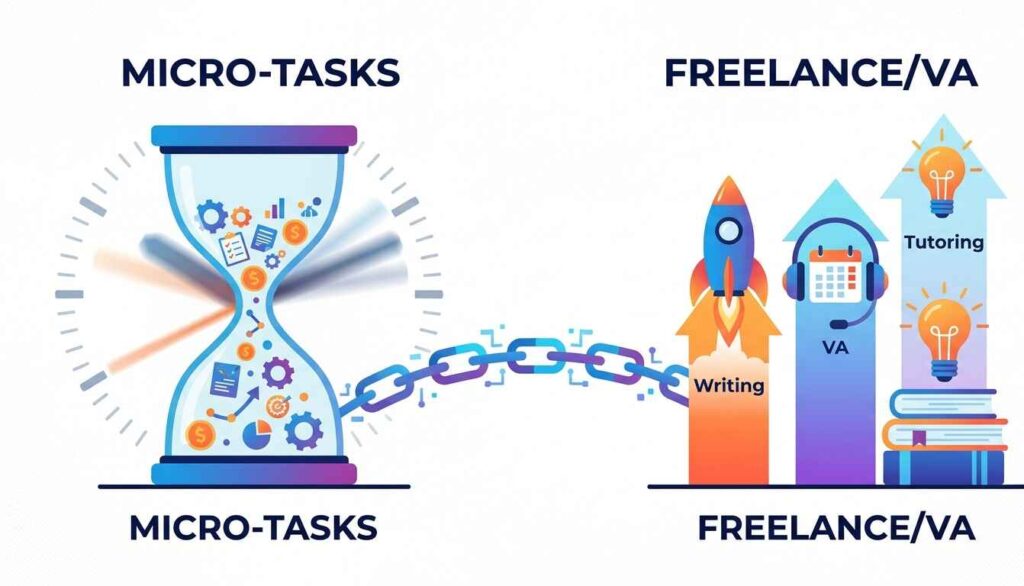
6. Micro-Task and Survey Platforms
I’ll be transparent about this category: survey sites and micro-task apps will not replace a part-time income. The per-task rates are low and the earning ceiling is real.
Where they genuinely work is as in-the-gaps income — something you do during a fifteen-minute break, while waiting for a lecture to start, or while watching something you’ve already seen. For that use case, they’re legitimately useful.
The platforms with the best reputation for actually paying out: Swagbucks (points redeemable for gift cards or cash via PayPal), Survey Junkie (straightforward survey platform), and InboxDollars. For micro-tasks specifically, Amazon Mechanical Turk and Clickworker mentioned above are more consistently valuable.
The honest expectation is a few dollars to maybe $50–$100 per month depending on how much time you put in. Treat it as a supplement to other income sources, not a standalone job.
7. Virtual Assistant Work
Virtual assistants handle tasks that business owners and professionals need done but don’t want to spend their own time on: inbox management, appointment scheduling, travel research, data organization, customer service email responses, basic research, formatting documents, and dozens of other small operational tasks.
The work is varied, the hours are flexible, and the only real requirement is being organized, reliable, and communicative. If you’re the kind of person who manages your own schedule well and handles administrative details without dropping things, VA work is a natural fit.
Where to find it: Upwork has consistent VA job postings across a wide range of complexity levels. Belay and Time Etc specialize in matching VAs with clients and tend to have more professional client relationships and steadier work, though they’re more selective in who they accept. People Per Hour and Freelancer.com are worth knowing as additional platforms.
Starting rates for general VA work run $10–$20 per hour, with specialized VAs (those who handle bookkeeping, customer service platforms, specific software tools) earning $30–$50 per hour and higher.
8. Selling Notes and Study Materials
This one is worth including because it’s uniquely suited to students — it monetizes work you’re already doing.
Platforms like Stuvia, Nexus Notes, and StudyLib let you upload study notes, summaries, practice exams, and other academic materials and sell them to other students. You’ve already written the notes. Uploading them takes minutes. Each sale after that is essentially free money.
The materials that sell best are detailed, organized notes for popular courses with high enrollment, particularly for subjects students find difficult — accounting, organic chemistry, statistics, calculus, economics, and similar courses where students desperately want clear summaries.
This is never going to be a primary income source for most students, but it’s one of the more logical ways to squeeze additional value from effort you’re already putting in. If you’re taking thorough notes anyway, why not earn something from them?
Mistakes That Cost Students Time and Money
Signing up for ten platforms at once and doing nothing well on any of them. Pick one or two sources that match your skills, put real effort into them for four to six weeks, and measure results before adding anything else. Scattered effort produces scattered results.
Underpricing everything to compete with lower-quality providers. On platforms like Fiverr and Upwork, competing purely on price attracts clients who value price over quality. Those clients are usually the most demanding, the least loyal, and the most likely to leave bad reviews over minor issues. Price your work at a rate that reflects genuine effort and screens for clients who care about results.
Treating online jobs as entirely passive. Even the more flexible options — transcription, data entry, tutoring — require consistent engagement. Platforms give higher visibility to active profiles. Clients leave for more responsive providers. The students who earn consistently are the ones who show up regularly, even if only for a few hours per week.
Getting caught by scammy platforms. Legitimate online jobs don’t ask you to pay upfront to access work. They don’t promise unusually high earnings for simple tasks. They don’t require personal financial details beyond standard payment setup. If something sounds too easy for what it’s paying, research it before investing time.
Starting This Week Without Overthinking It
Here’s a practical framework: look at the list above and identify the one job that requires the least distance between where you are now and earning your first dollar.
If you write well and have subject knowledge — start with writing or tutoring. If you’re fast and detail-oriented — try transcription or data entry. If you’ve spent real time on social media and understand what works — approach one local business about their Instagram.
Then do one concrete thing today. Create the profile. Apply for the first gig. Send the first pitch email.
The gap between “I’m going to do this” and “I have actually done this” is where most people live indefinitely. The students who end up with real online income are the ones who close that gap in a day rather than a semester.
Your schedule is the constraint. Your skills are the asset. Finding work that respects the first and uses the second is entirely possible — and based on what’s available right now, it’s easier to start than it’s ever been.